
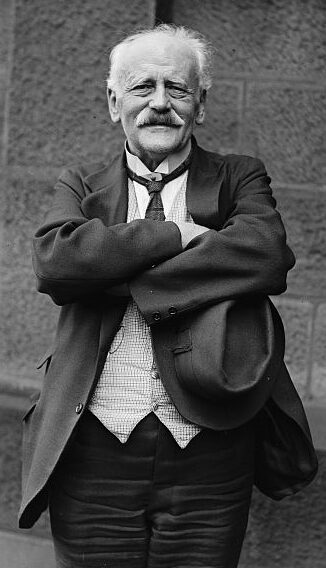
Otto Stapf
Otto Stapf was an Austrian botanist. Born March 23, 1857, in Bad Ischl. Died August 3, 1933, in Innsbruck. Educated at University of Vienna. Awards include Fellow of the Royal Society, Linnean Medal and Veitch Memorial Medal.
Facts
15 facts · 1 confirmed by two sources · 3 cited · 10 from one source · 1 where the sources disagree
What’s different
- Born: we show March 23, 1857 (Sources disagree). Wikipedia says April 23, 1857
- Died: we show August 3, 1933 (Confirmed). Wikidata also lists August 4, 1933
Where this comes from
Papalocal keeps its own record. It started from these sources; what each one said is kept here as it was copied, so a change on their side never changes this page by itself. Tap one to read its version.
What Wikidata says · copied November 18, 2026 · revision 2568890369
- Described as
- Austrian botanist (1857-1933)
- Other names
- Stapf
- Born
- March 23, 1857 · 2 references
- Died
- August 3, 1933 · 1 reference; August 4, 1933 · 1 reference
- Born in
- Bad Ischl
- Died in
- Innsbruck · 1 reference
- Citizen of
- Austria
- Occupation
- botanist · 1 reference; university teacher; scientific collector · 1 reference
- Worked for
- University of Vienna
- Education
- University of Vienna
- Member of
- Royal Society of London (1908–)
- Awards
- Fellow of the Royal Society; Linnean Medal (1927); Veitch Memorial Medal (1931)
- Field
- botany
- Wikipedias with a page
- 21
Wikidata item Q78630 (wikidata.org/wiki/Q78630), public domain (CC0). Copied November 18, 2026.
What Wikipedia says · copied November 18, 2026 · revision 1337130712
Otto Stapf FRS (23 April 1857 – 3 August 1933) was an Austrian born botanist and taxonomist, the son of Joseph Stapf, who worked in the Hallstatt salt-mines. He grew up in Hallstatt and later published about the archaeological plant remains from the Late Bronze- and Iron Age mines that had been uncovered by his father.
Stapf studied botany in Vienna under Julius Wiesner, where he received his PhD with a dissertation on cristals and cristalloids in plants. 1882 he became assistant professor (Assistent) of Anton Kerner. In 1887 he was made Privatdozent (lecturer without a chair) in Vienna. He published the results of an expedition Jakob Eduard Polak, the personal physician of Nasr al-Din, the Shah of Persia, had conducted in 1882, and plants collected by Felix von Luschan in Lycia and Mesopotamia 1881–1883. In 1885, Polak sponsored Stapf to conduct a botanical expedition of his own to South- and Western Persia, which was to last nine month. This led to the discovery of numerous new species, which Stapf started to publish. Including Iris meda.
After his return, Stapf was harassed by his boss, Anton Kerner, who voiced his disapproval of his travels. It was rumoured that Kerner wanted Stapf's job for Richard Wettstein, the new husband of his daughter Adele. He publicly accused him of wrong identifications of plants collected during the expedition.
In the end, Stapf moved to Royal Botanic Gardens, Kew in 1890. He was keeper of the Herbarium from 1909 to 1920 and became British citizen in 1905. He was awarded the Linnean Medal in 1927.
In May 1908 he was elected a Fellow of the Royal Society. His candidacy citation read:Principal Assistant, Royal Botanic Gardens, Kew. He is at home in all branches of Scientific Botany, and is well known for the thoroughness of his work. His numerous publications have been chiefly in the field of Systematic Botany. Before coming to England, he spent nine months on a botanical exploration of Persia. His most important publications are: "Botan. Ergebnisse der Polak'schen Expedition nach Persien" (Memoirs of the Imperial Academy, Vienna, 1885–1886); "Beiträge zur Flora v Lycien, Carien u Mesopotamien" (ibid., 1885–1886); "Die Arten der Gattung Ephedra" (ibid., 1889); "Pedaliaceae and Martyniaceae" (Engler and Prantl's Die Natürlichen Pflanzenfamilien, 1895); "Flora of Mount Kinabalu in North Borneo" (Trans Linn Soc, 1894); "Melocanna bambusoides" (ibid., 1904); "Structure of Sararanga sinuosa" (Journ Linn Soc, 1896); "Dicellandra and Phaeoneuron" (ibid., 1900); "Monograph of the Indian Aconites" (Annals, Royal Botanic Garden, Calcutta, 1905). In Hooker's Icones Plantarum, about 100 plates with text, 1891–1905; part of "Gramineae" (Flora of British India, 1897); "Apocynaceae" (Flora of Tropical Africa, 1904); "Gramineae" (Flora Capensis, 1897–1900); "Lentibulariaceae" (ibid., 1904); "Pedaliaceae" (ibid., 1904).
He was also a member of the Austrian Academy of Sciences and the German botanical society.
- Born, in its opening lines
- April 23, 1857
- Died, in its opening lines
- August 3, 1933
From the Wikipedia article “Otto Stapf (botanist)” (en.wikipedia.org/wiki/Otto_Stapf_(botanist)), by its contributors, under CC BY-SA 4.0 (creativecommons.org/licenses/by-sa/4.0/). Copied November 18, 2026; not changed.
Confirmed Two sources agree. Cited One source, and it names where it got it. One source One source, without a reference of its own. Sources disagree The sources disagree. We show the best-supported value and keep theirs below.
