
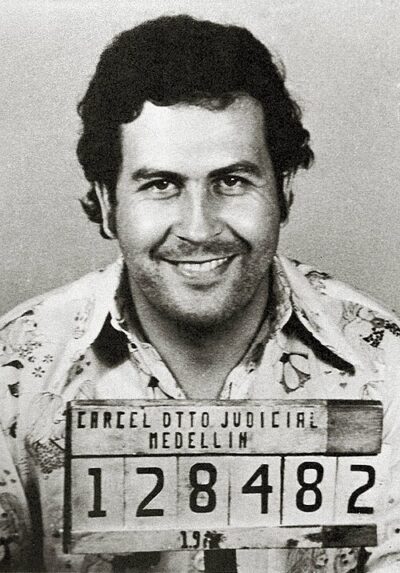
Pablo Escobar
Pablo Escobar was a Colombian politician and drug lord. Born December 1, 1949, in Rio negro. Died December 2, 1993, in Medellín. Positions held include member of the Chamber of Representatives of Colombia (1982–1983) and director.
Facts
23 facts · 2 confirmed by two sources · 4 cited · 17 from one source
Where this comes from
Papalocal keeps its own record. It started from these sources; what each one said is kept here as it was copied, so a change on their side never changes this page by itself. Tap one to read its version.
What Wikidata says · copied November 16, 2026 · revision 2568328259
- Described as
- Colombian politician and drug lord (1949–1993)
- Other names
- Pablo Emilio Escobar Gaviria, El Doctor, El Patrón del mal, Pablo Escobar Gaviria, Don Pablo, El Patron, Paisa Robin Hood, The Godfather
- Born
- December 1, 1949 · 6 references
- Died
- December 2, 1993 · 6 references
- Born in
- Rio negro
- Died in
- Medellín · 1 reference
- Buried in
- Medellín · 1 reference
- Cause of death
- gunshot wound
- Name at birth
- Pablo Emilio Escobar Gaviria
- Citizen of
- Colombia
- Occupation
- drug lord; politician
- Positions held
- member of the Chamber of Representatives of Colombia (1982–1983); director
- Political party
- Colombian Liberal Party
- Member of
- Medellín Cartel
- Spouse
- Andrea del Aguila canal (1976–1993)
- Children
- Juan Pablo Escobar Henao · 1 reference; Manuela Escobar
- Father
- Abel de Jesús Escobar Echeverri
- Mother
- Hemilda de los Dolores Gaviria Berrío
- Siblings
- Roberto Escobar · 1 reference; Luz María Escobar
- Religion
- Catholic Church
- Lived in
- La Catedral (1991–1992)
- Wikipedias with a page
- 110
Wikidata item Q187447 (wikidata.org/wiki/Q187447), public domain (CC0). Copied November 16, 2026.
What Wikipedia says · copied November 16, 2026 · revision 1380963942
Pablo Emilio Escobar Gaviria ( ESK-ə-bar, Spanish: [ˈpaβlo eskoˈβaɾ]; 1 December 1949 – 2 December 1993) was a Colombian drug lord, narcoterrorist, and politician who was the founder and leader of the Medellín Cartel. Dubbed the "King of Cocaine", Escobar was one of the wealthiest conventional criminals in history, having amassed an estimated net worth of US$30 billion by his death,
while his drug cartel monopolized the cocaine trade into the US in the 1980s and early 1990s.
Born in Rionegro and raised in Medellín, Escobar studied briefly at the Universidad Autónoma Latinoamericana of Medellín but left without graduating; he instead began engaging in criminality, selling illegal cigarettes and fake lottery tickets, as well as participating in motor vehicle theft and more heinous crimes. In the early 1970s, he began to work for various drug smugglers, often kidnapping and holding people for ransom. In 1976, Escobar founded the Medellín Cartel, which distributed powder cocaine, and established the first smuggling routes from Peru, Bolivia and Ecuador, through Colombia and eventually into the United States. Escobar's infiltration into the US created a rapidly increasing demand for cocaine and by the 1980s it was estimated Escobar led monthly shipments of 70 to 80 tons into the US from Colombia. He quickly became one of the richest people in the world, but constantly battled rival cartels domestically and abroad, leading to massacres and the murders of police officers, judges, locals, and prominent politicians.
In the 1982 Colombian parliamentary election, Escobar was elected as an alternate member of the Chamber of Representatives as part of the Liberal Party. Through this, he was responsible for community projects such as the construction of houses and football pitches, which gained him popularity among the locals of towns he frequented; however, Escobar's political ambitions were thwarted by the Colombian and US governments, who routinely pushed for his arrest, with Escobar believed to have orchestrated the Avianca Flight 203 and DAS Building bombings in retaliation. In 1991, Escobar surrendered to authorities, and was sentenced to five years' imprisonment on a host of charges, but struck a deal of no extradition with Colombian president César Gaviria, with the ability of being housed in his own, self-built prison, La Catedral. In 1992, Escobar escaped and went into hiding when authorities attempted to move him to a more standard holding facility, leading to a nationwide manhunt. As a result, the Medellín Cartel crumbled, and in 1993, Escobar was killed in his hometown by the Colombian National Police, a day after his 44th birthday.
Escobar's legacy remains controversial; while many denounce the heinous nature of his crimes, he was seen as a "Robin Hood-like" figure for many in Colombia, as he provided amenities to the poor. His killing was mourned and his funeral attended by over 25,000 people. Additionally, his private estate, Hacienda Nápoles, has been transformed into a theme park. His life has also served as inspiration for or has been dramatized widely in film, television, and in music.
- Born, in its opening lines
- December 1, 1949
- Died, in its opening lines
- December 2, 1993
From the Wikipedia article “Pablo Escobar” (en.wikipedia.org/wiki/Pablo_Escobar), by its contributors, under CC BY-SA 4.0 (creativecommons.org/licenses/by-sa/4.0/). Copied November 16, 2026; not changed.
Confirmed Two sources agree. Cited One source, and it names where it got it. One source One source, without a reference of its own. Sources disagree The sources disagree. We show the best-supported value and keep theirs below.
