
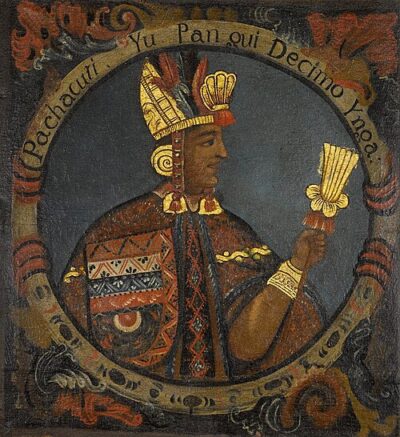
Pachacútec
Pachacútec was the 11th Inca Emperor. Born 1391, in Cusco. Died 1471, in Cusco. Positions held include Sapa Inca (1438–1471).
Facts
13 facts · 0 confirmed by two sources · 0 cited · 13 from one source
Where this comes from
Papalocal keeps its own record. It started from these sources; what each one said is kept here as it was copied, so a change on their side never changes this page by itself. Tap one to read its version.
What Wikidata says · copied November 16, 2026 · revision 2521005343
- Described as
- 11th Inca Emperor
- Other names
- Pachacuti, Pachacutec, Pachacuti Inca Yupanqui
- Born
- 1391
- Died
- 1471
- Born in
- Cusco
- Died in
- Cusco
- Occupation
- politician; sovereign
- Positions held
- Sapa Inca (1438–1471)
- Children
- Amaru Topa Inca; Túpac Inca Yupanqui; Mama Ocllo Coya
- Father
- Wiracocha Inca
- Siblings
- Cápac Yupanqui; Inca Urco
- Wikipedias with a page
- 46
Wikidata item Q213758 (wikidata.org/wiki/Q213758), public domain (CC0). Copied November 16, 2026.
What Wikipedia says · copied November 16, 2026 · revision 1383046923
Pachacuti Inca Yupanqui, also called Pachacútec (Quechua: Pachakutiy Inka Yupanki, pronounced [ˈpatʃa ˈkuti ˈiŋka juˈpaŋki]), was the ninth Sapa Inca of the Chiefdom of Cusco, which he transformed into the Inca Empire (Tawantinsuyu). Most archaeologists now believe that the famous Inca site of Machu Picchu was built as an estate for Pachacuti.
In Quechua, the cosmogonical concept of pachakutiy means "the turn of the world" and yupanki could mean "honorable lord". During his reign, Cusco grew from a small town into an empire that could compete with, and eventually overtake, the Chimú empire on the northern coast. He began an era of conquest that, within three generations, expanded the Inca dominion from the valley of Cusco to a sizeable part of western South America. According to the Inca chronicler Garcilaso de la Vega, Pachacuti created the Inti Raymi to celebrate the new year in the Andes of the southern hemisphere. Pachacuti is often linked to the origin and expansion of the cult of Inti.
Following his death, Pachacuti's deeds were transmitted through various means, including genealogical histories, life histories, and quipus, kept near his royal mummy.
Accessing power following the Chanka–Inca War, Pachacuti conquered territories around Lake Titicaca and Lake Poopó in the south, parts of the eastern slopes of the Andes Mountains near the Amazon rainforest in the east, lands up to the Quito basin in the north, and lands from Tumbes to possibly the coastal regions from Nasca and Camaná to Tarapacá. These conquests were achieved with the help of many military commanders, and they initiated Inca imperial expansion in the Andes.
Pachacuti is considered by some anthropologists to be one of the first historical emperors of the Incas, and by others to be a mythological and cosmological representation of the beginning of the era of Inca imperial expansion.
From the Wikipedia article “Pachacuti” (en.wikipedia.org/wiki/Pachacuti), by its contributors, under CC BY-SA 4.0 (creativecommons.org/licenses/by-sa/4.0/). Copied November 16, 2026; not changed.
Confirmed Two sources agree. Cited One source, and it names where it got it. One source One source, without a reference of its own. Sources disagree The sources disagree. We show the best-supported value and keep theirs below.
