
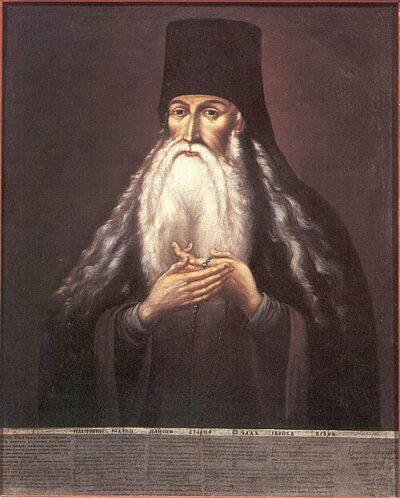
Paisius Velichkovsky
Paisius Velichkovsky was an Orthodox monk. Born December 21, 1722, in Poltava. Died November 15, 1794, in Neamț Monastery. Educated at Kiev Theological Academy and National University of Kyiv-Mohyla Academy.
Facts
8 facts · 1 confirmed by two sources · 2 cited · 4 from one source · 1 where the sources disagree
What’s different
- Born: we show December 21, 1722 (Sources disagree). Wikipedia says December 20, 1722
Where this comes from
Papalocal keeps its own record. It started from these sources; what each one said is kept here as it was copied, so a change on their side never changes this page by itself. Tap one to read its version.
What Wikidata says · copied November 18, 2026 · revision 2547049838
- Described as
- Orthodox monk (1722-1794)
- Other names
- Paisij Velyčkovsʹkyj, St Paisy Velichkovsky
- Born
- December 21, 1722 · 1 reference
- Died
- November 15, 1794 · 1 reference
- Born in
- Poltava · 1 reference
- Died in
- Neamț Monastery
- Occupation
- monk · 1 reference
- Education
- Kiev Theological Academy; National University of Kyiv-Mohyla Academy
- Religion
- Eastern Orthodoxy
- Wikipedias with a page
- 22
Wikidata item Q2328226 (wikidata.org/wiki/Q2328226), public domain (CC0). Copied November 18, 2026.
What Wikipedia says · copied November 18, 2026 · revision 1342810837
Paisius Velichkovsky or Wieliczkowski (Paisie de la Neamţ in Romanian; Паисий Величковский in Russian; Паїсій Величковський in Ukrainian; 20 December 1722 – 15 November 1794) was an Eastern Orthodox monk and theologian who helped spread staretsdom or the concept of the spiritual elder to the Slavic world. He is a pivotal figure in Orthodox Church history.
- Born, in its opening lines
- December 20, 1722
- Died, in its opening lines
- November 15, 1794
From the Wikipedia article “Paisius Velichkovsky” (en.wikipedia.org/wiki/Paisius_Velichkovsky), by its contributors, under CC BY-SA 4.0 (creativecommons.org/licenses/by-sa/4.0/). Copied November 18, 2026; not changed.
Confirmed Two sources agree. Cited One source, and it names where it got it. One source One source, without a reference of its own. Sources disagree The sources disagree. We show the best-supported value and keep theirs below.
