
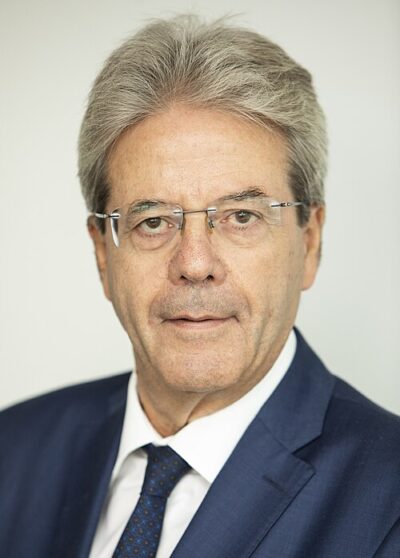
Paolo Gentiloni
Paolo Gentiloni is an Italian politician. Born November 22, 1954, in Rome. Positions held include Italian Minister of Communications (2006–2008), Prime Minister of Italy (2016–2018) and Italian Minister of Agriculture (2018). Educated at Sapienza University of Rome.
Facts
20 facts · 1 confirmed by two sources · 9 cited · 10 from one source
Where this comes from
Papalocal keeps its own record. It started from these sources; what each one said is kept here as it was copied, so a change on their side never changes this page by itself. Tap one to read its version.
What Wikidata says · copied November 16, 2026 · revision 2562799703
- Described as
- Italian politician (born 1954)
- Other names
- Paolo Gentiloni Silveri
- Born
- November 22, 1954 · 4 references
- Born in
- Rome · 1 reference
- Name at birth
- Paolo Gentiloni Silveri
- Citizen of
- Italy · 2 references
- Occupation
- politician · 1 reference; journalist (1990–) · 1 reference
- Positions held
- Italian Minister of Communications (2006–2008); Prime Minister of Italy (2016–2018) · 1 reference; Italian Minister of Agriculture (2018); Italian Minister of Foreign Affairs (2014–2016); member of the Chamber of Deputies of the Italian Republic (2001–2019) · 1 reference; President of the Democratic Party (2019–2020) · 1 reference; European Commissioner for Economy (2019–2024) · 1 reference
- Political party
- Democratic Party (2007–) · 1 reference; Workers' Movement for Socialism; Proletarian Unity Party; Democracy Is Freedom – The Daisy (–2007)
- Education
- Sapienza University of Rome
- Religion
- Catholicism
- Website
- http://www.paologentiloni.it/ · 1 reference
- Wikipedias with a page
- 85
Wikidata item Q1071031 (wikidata.org/wiki/Q1071031), public domain (CC0). Copied November 16, 2026.
What Wikipedia says · copied November 16, 2026 · revision 1380826478
Paolo Gentiloni Silveri (Italian pronunciation: [ˈpaːolo dʒentiˈloːni]; born 22 November 1954) is an Italian politician who was European Commissioner for Economy in the Von der Leyen Commission from 1 December 2019 to 30 November 2024. He had previously served as prime minister of Italy from December 2016 to June 2018.
After a lengthy career in local politics, Gentiloni was elected to the Chamber of Deputies in 2001. He served in the Cabinet under Romano Prodi as Minister of Communications from 2006 to 2008. In 2007, he was one of the senior founding members of the Democratic Party, and went on to become party president from 2019 to 2020. Gentiloni later served as Minister of Foreign Affairs from 2014 to 2016 in the Cabinet of Matteo Renzi. Following Renzi's resignation in the wake of a failed constitutional referendum, the Democratic Party held discussions on his replacement. Eventually, Gentiloni won support from his colleagues, and President Sergio Mattarella appointed him Prime Minister on 12 December 2016.
Despite being considered a caretaker prime minister upon his appointment, during his time in office Gentiloni successfully delivered major reforms that had been delayed for many years, including the implementation of the advance healthcare directive, the reform of the voluntary sector and the passage of a new electoral law. He also introduced stricter rules on immigration and social security, in an attempt to counteract the European migration crisis. In foreign policy, Gentiloni built on his time as foreign minister by projecting a strong Europeanist stance, whilst at the same time building close relations with the Arab countries of the Persian Gulf, and notably overseeing a normalisation of Italian relations with India after years of tensions. Gentiloni resigned as Prime Minister following the 2018 election. In September 2019, he was nominated by the Conte Government to become Italy's new European Commissioner, and was given the key portfolio of overseeing the European Union Economy.
- Born, in its opening lines
- November 22, 1954
From the Wikipedia article “Paolo Gentiloni” (en.wikipedia.org/wiki/Paolo_Gentiloni), by its contributors, under CC BY-SA 4.0 (creativecommons.org/licenses/by-sa/4.0/). Copied November 16, 2026; not changed.
Confirmed Two sources agree. Cited One source, and it names where it got it. One source One source, without a reference of its own. Sources disagree The sources disagree. We show the best-supported value and keep theirs below.
