
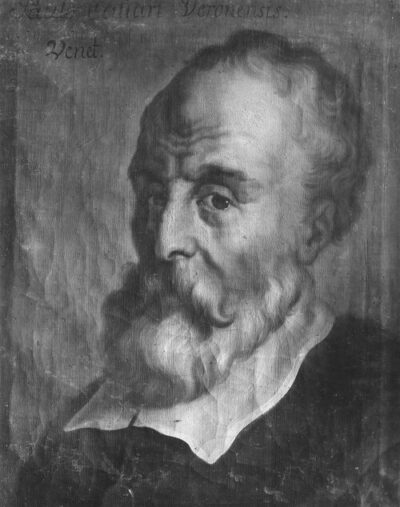
Paolo Veronese
Paolo Veronese was an Italian painter of the Renaissance. Born 1528, in Verona. Died April 19, 1588, in Venice. Known for Villa Barbaro, The Baptism of Christ and Christ and the Centurion.
Facts
32 facts · 2 confirmed by two sources · 13 cited · 17 from one source
Where this comes from
Papalocal keeps its own record. It started from these sources; what each one said is kept here as it was copied, so a change on their side never changes this page by itself. Tap one to read its version.
What Wikidata says · copied November 16, 2026 · revision 2569122944
- Described as
- Italian painter of the Renaissance (1528–1588)
- Other names
- Paolo Caliati Veronese, Poul Veronese, Paolo Vironeus, Paolo Cagliari gen. Veronese, Paolo Caliari il Veronese, Paolo Cagliari Veronese, dit Paul Veronese Paul Calliari, Paolo Caliari Genannt Veronese, detto Paolo Veronese Paolo Cagliari, Paolo Calliari Veronese, P. Veroness, Le Paul Véronèse
- Born
- 1528 · 5 references
- Died
- April 19, 1588 · 4 references
- Born in
- Verona · 2 references
- Died in
- Venice · 2 references
- Buried in
- San Sebastiano
- Name at birth
- Paolo Caliari
- Citizen of
- Republic of Venice
- Occupation
- painter · 2 references; draftsperson · 1 reference; architectural drafter · 1 reference; visual artist · 1 reference
- Genre
- portrait · 1 reference; portrait painting · 1 reference; history painting · 2 references; allegory · 1 reference; religious art · 1 reference
- Known for
- Villa Barbaro; The Baptism of Christ · 1 reference; Christ and the Centurion · 1 reference; Madonna Enthroned with Child, St John the Baptist, St Louis of Toulouse and Donors · 1 reference; Saints Philip and James the Less · 1 reference; The Annunciation · 1 reference; Annunciation · 1 reference; The Baptism of Christ · 1 reference; Burning bush · 1 reference; Holy Family with Sts Anthony Abbot, Catherine and the Infant John the Baptist · 1 reference
- Field
- painting · 1 reference
- Spouse
- Elena Badile
- Children
- Carlo Caliari · 1 reference; Gabriele Caliari
- Siblings
- Benedetto Caliari · 1 reference
- Religion
- Catholicism
- Wikipedias with a page
- 79
Wikidata item Q9440 (wikidata.org/wiki/Q9440), public domain (CC0). Copied November 16, 2026.
What Wikipedia says · copied November 16, 2026 · revision 1384445287
Paolo Caliari (1528 – 19 April 1588), known as Paolo Veronese ( VERR-ə-NAY-zay, -zee, US also -see; Italian: [ˈpaːolo veroˈneːze, -eːse]), was an Italian Renaissance painter based in Venice, known for extremely large history paintings of religion and mythology, such as The Wedding at Cana (1563) and The Feast in the House of Levi (1573). Included with Titian, a generation older, and Tintoretto, a decade senior, Veronese is one of the "great trio that dominated Venetian painting of the cinquecento" and the Late Renaissance in the 16th century. Known as a supreme colorist, and after an early period with Mannerism, Paolo Veronese developed a naturalist style of painting, influenced by Titian.
His most famous works are elaborate narrative cycles, executed in a dramatic and colorful style, full of majestic architectural settings and glittering pageantry. His large paintings of biblical feasts, crowded with figures, painted for the refectories of monasteries in Venice and Verona are especially famous, and he was also the leading Venetian painter of ceilings. Most of these works remain in situ, or at least in Venice, and his representation in most museums is mainly composed of smaller works such as portraits that do not always show him at his best or most typical.
He has always been appreciated for "the chromatic brilliance of his palette, the splendor and sensibility of his brushwork, the aristocratic elegance of his figures, and the magnificence of his spectacle", but his work has been felt "not to permit expression of the profound, the human, or the sublime", and of the "great trio" he has often been the least appreciated by modern criticism. Nonetheless, "many of the greatest artists ... may be counted among his admirers, including Rubens, Watteau, Tiepolo, Delacroix, and Renoir".
- Born, in its opening lines
- 1528
- Died, in its opening lines
- April 19, 1588
From the Wikipedia article “Paolo Veronese” (en.wikipedia.org/wiki/Paolo_Veronese), by its contributors, under CC BY-SA 4.0 (creativecommons.org/licenses/by-sa/4.0/). Copied November 16, 2026; not changed.
Confirmed Two sources agree. Cited One source, and it names where it got it. One source One source, without a reference of its own. Sources disagree The sources disagree. We show the best-supported value and keep theirs below.
