
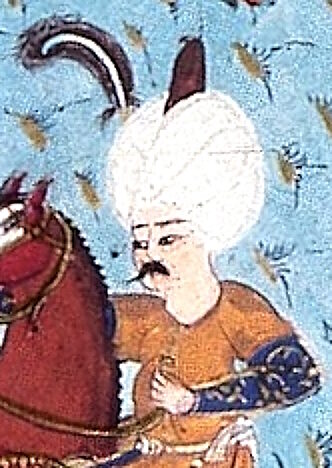
Pargalı Ibrahim Pasha
Pargalı Ibrahim Pasha was the 29º Ottoman Grand Vizier. Born 1495, in Parga. Died March 15, 1536, in Istanbul. Positions held include grand vizier of the Ottoman Empire (1523–1536), Beylerbey of Egypt (1525) and stadtholder. Educated at Enderûn.
Facts
20 facts · 0 confirmed by two sources · 7 cited · 13 from one source
Where this comes from
Papalocal keeps its own record. It started from these sources; what each one said is kept here as it was copied, so a change on their side never changes this page by itself. Tap one to read its version.
What Wikidata says · copied November 16, 2026 · revision 2562650875
- Described as
- 29º Ottoman Grand Vizier (1493-1536)
- Other names
- Frenk Ibrahim Pasha, Makbul Ibrahim Pasha, Maktul Ibrahim Pasha, Pargalı İbrahim Paşa
- Born
- 1495 · 2 references
- Died
- March 15, 1536
- Born in
- Parga
- Died in
- Istanbul · 1 reference
- Cause of death
- strangling
- Citizen of
- Ottoman Empire · 1 reference; Republic of Venice (1493–)
- Occupation
- politician; military personnel; writer · 1 reference; courtier · 1 reference; grand vizier · 1 reference
- Positions held
- grand vizier of the Ottoman Empire (1523–1536); Beylerbey of Egypt (1525); stadtholder · 1 reference
- Education
- Enderûn
- Religion
- Eastern Orthodoxy (1493–); Sunni Islam
- Military rank
- military personnel; politician
- Wikipedias with a page
- 49
Wikidata item Q511943 (wikidata.org/wiki/Q511943), public domain (CC0). Copied November 16, 2026.
What Wikipedia says · copied November 16, 2026 · revision 1384474911
Pargalı Ibrahim Pasha (c. 1495, Parga – 15 March 1536, Constantinople) was an Ottoman statesman who served as Grand Vizier from 1523 to 1536 during the reign of Suleiman I, and played a role in important political and military events. Because of the authority he wielded, he is regarded as the brains behind the Ottoman Empire's foreign policy.
Although his ethnic origin is not known with certainty, various sources have described him as being of Greek, Italian, Albanian, or Croatian origin. His father is believed to have been a sailor or fisherman living in Parga. Brought to Manisa at a young age through the devşirme system, Ibrahim was taken into the service of Prince Suleiman there and remained at his side until his death. He participated in the Belgrade campaign in 1521 and the Rhodes campaign in 1522. Rising rapidly during the early years of Suleiman's reign, he first became chief of the imperial chamber, and was later unexpectedly appointed Grand Vizier. In addition, he held the offices of beylerbey of Rumelia and Anatolia, as well as that of serasker.
Shortly after marrying in a lavish wedding in 1524, he was sent to Egypt, where he was tasked with restoring order following the rebellion of Hain Ahmed Pasha. While traveling to Egypt by land, he listened to the complaints of the population at many points along the route and resolved them, and introduced numerous reforms in Egypt. He played a major role in the Ottoman victory at the Battle of Mohács in Hungary in 1526. He participated in the First Siege of Vienna in 1529 and conducted the negotiations for the Treaty of Constantinople, signed with Austria in 1533, which placed the Austrian archduke on an equal footing with the Ottoman Grand Vizier. As commander of the Ottoman army during the Irakeyn campaign against the Safavids, he captured the Iranian city of Tabriz in August 1534. In 1536, Ibrahim Pasha, who had been invited to the palace for iftar on the evening bridging 14 and 15 March, was strangled to death during the night in his chamber at the palace by four deaf-mute executioners on the orders of Sultan Suleiman.
Ibrahim Pasha was Sultan Suleiman's chief adviser and closest confidant. In addition to Turkish, he was fluent in Persian, Greek, Serbian, and Italian. He had a strong interest in the arts and had received intensive musical training since childhood. In addition, during his 13-year tenure as Grand Vizier, he commissioned the construction of numerous mosques, madrasas, baths, and fountains. As a statesman who attained an extraordinary degree of fame and prestige for his time and played decisive roles in the development of the period's foreign political events, Pargalı Ibrahim Pasha is regarded by modern historians as one of the most important and successful Ottoman grand viziers.
From the Wikipedia article “Pargalı Ibrahim Pasha” (en.wikipedia.org/wiki/Pargalı_Ibrahim_Pasha), by its contributors, under CC BY-SA 4.0 (creativecommons.org/licenses/by-sa/4.0/). Copied November 16, 2026; not changed.
Confirmed Two sources agree. Cited One source, and it names where it got it. One source One source, without a reference of its own. Sources disagree The sources disagree. We show the best-supported value and keep theirs below.
