
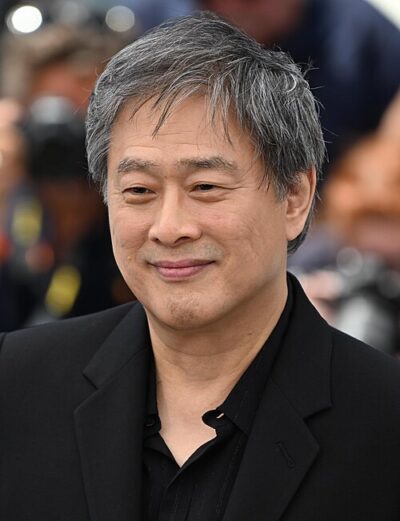
Park Chan-wook
Park Chan-wook is a South Korean filmmaker. Born August 23, 1963, in Seoul. Known for Sympathy for Lady Vengeance, Oldboy and Sympathy for Mr. Vengeance. Educated at Sogang University. Awards include Golden Lion, Grand Jury Prize of the Venice Film Festival and Jury Prize.
Facts
28 facts · 1 confirmed by two sources · 6 cited · 21 from one source
Where this comes from
Papalocal keeps its own record. It started from these sources; what each one said is kept here as it was copied, so a change on their side never changes this page by itself. Tap one to read its version.
What Wikidata says · copied November 16, 2026 · revision 2568216793
- Described as
- South Korean filmmaker (born 1963)
- Other names
- Chan-wook Park, Park Chan-uk
- Born
- August 23, 1963 · 4 references
- Born in
- Seoul · 1 reference
- Citizen of
- South Korea · 1 reference
- Occupation
- screenwriter · 1 reference; film director · 2 references; film producer · 1 reference; film critic; director · 1 reference
- Political party
- New Progressive Party
- Worked for
- Dong-Ah Institute of Media and Arts
- Education
- Sogang University
- Known for
- Sympathy for Lady Vengeance (2005); Oldboy (2003); Sympathy for Mr. Vengeance (2002); Joint Security Area (2000)
- Awards
- Golden Lion (2005); Grand Jury Prize of the Venice Film Festival (2004); Jury Prize (2009); Cannes Film Festival Grand Prix (2004); Sitges Film Festival Best Feature-Length Film award (2004); Sitges Film Festival Best Screenplay award (2007); Cannes Best Director Award (2022); Grand Bell Awards; Time Machine Award (2009); Order of Cultural Merit, 3rd class (2004) · 1 reference
- Field
- film
- Siblings
- Park Chan-kyong · 1 reference
- Height
- 1.69 m (5 ft 7 in)
- Wikipedias with a page
- 50
Wikidata item Q315484 (wikidata.org/wiki/Q315484), public domain (CC0). Copied November 16, 2026.
What Wikipedia says · copied November 16, 2026 · revision 1383794876
Park Chan-wook (Korean: 박찬욱; pronounced [pak̚ tɕʰanuk̚]; born August 23, 1963) is a South Korean filmmaker and former film critic. Widely regarded as a leading figure in South Korean and 21st-century world cinema, he is known for films that blend crime, mystery, and thriller elements with other genres. His films are noted for their cinematography, framing, black humor, and often brutal subject matter.
After two unsuccessful films in the 1990s which he has since largely disowned, Park came to prominence with his acclaimed third directorial effort, Joint Security Area (2000), which became the highest-grossing film in South Korean history at the time and which Park himself prefers to be regarded as his directorial debut. Using his newfound creative freedom, he would go on to direct the films forming his unofficial The Vengeance Trilogy: Sympathy for Mr. Vengeance (2002), a financial failure that polarized critics, followed by Oldboy (2003) and Lady Vengeance (2005), both of which received critical acclaim and were financially successful. Oldboy in particular is regarded as one of the greatest films ever made, and helped establish Park as a well-known director outside his native country.
Most of Park's work following The Vengeance Trilogy was also commercially and critically successful both in South Korea and internationally, such as Thirst (2009), The Handmaiden (2016), which earned Park the BAFTA Award for Best Film Not in the English Language, and Decision to Leave (2022), which won the Best Director award at the 2022 Cannes Film Festival. He directed the English-language miniseries The Little Drummer Girl (2018) and The Sympathizer (2024). His 2025 film No Other Choice was nominated for the Golden Globe for Best Foreign Language Film and shortlisted for the Academy Award for Best International Feature Film.
- Born, in its opening lines
- August 23, 1963
From the Wikipedia article “Park Chan-wook” (en.wikipedia.org/wiki/Park_Chan-wook), by its contributors, under CC BY-SA 4.0 (creativecommons.org/licenses/by-sa/4.0/). Copied November 16, 2026; not changed.
Confirmed Two sources agree. Cited One source, and it names where it got it. One source One source, without a reference of its own. Sources disagree The sources disagree. We show the best-supported value and keep theirs below.
