
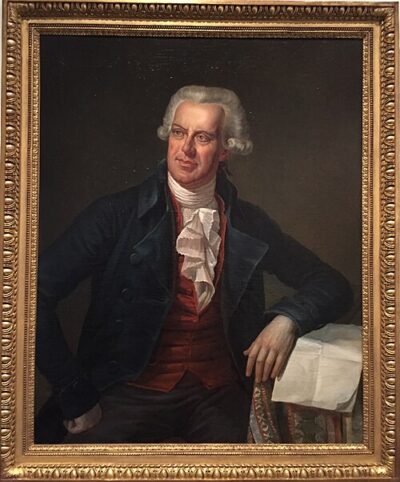
Pasquale Paoli
Pasquale Paoli was a Corsican leader. Born April 6, 1725, in Morosaglia. Died February 5, 1807, in London. Awards include Fellow of the Royal Society.
Facts
14 facts · 2 confirmed by two sources · 4 cited · 8 from one source
Where this comes from
Papalocal keeps its own record. It started from these sources; what each one said is kept here as it was copied, so a change on their side never changes this page by itself. Tap one to read its version.
What Wikidata says · copied November 16, 2026 · revision 2564296468
- Described as
- Corsican leader (1725–1807)
- Other names
- Pasquali Paoli, Corsica Paoli, Pasquale de Paoli
- Born
- April 6, 1725 · 2 references
- Died
- February 5, 1807 · 5 references
- Born in
- Morosaglia
- Died in
- London · 1 reference
- Citizen of
- Corsican Republic; Republic of Genoa
- Occupation
- politician; military officer; lieutenant general · 1 reference; Commander · 1 reference; freedom fighter · 1 reference
- Member of
- Royal Society of London (1774–)
- Awards
- Fellow of the Royal Society
- Military rank
- generalissimo
- Wikipedias with a page
- 52
Wikidata item Q152346 (wikidata.org/wiki/Q152346), public domain (CC0). Copied November 16, 2026.
What Wikipedia says · copied November 16, 2026 · revision 1374611011
Filippo Antonio Pasquale de' Paoli (Italian pronunciation: [fiˈlippo anˈtɔːnjo paˈskwaːle de ˈpaːoli]; Corsican: Pasquale or Pasquali Paoli; French: Philippe-Antoine-Pascal Paoli; 6 April 1725 – 5 February 1807) was a Corsican patriot, statesman, and military leader who was at the forefront of resistance movements against the Genoese and later French rule over the island. He became the President of the Executive Council of the General Diet of the People of Corsica and wrote the Constitution of the state.
The Corsican Republic (1755–1769) was a representative democracy asserting that the elected Diet of Corsican representatives had no master. Paoli held his office by election and not by appointment. It made him commander-in-chief of the armed forces as well as chief magistrate. Paoli's government claimed the same jurisdiction as the Republic of Genoa. In terms of de facto exercise of power, the Genoese held the coastal cities, which they could defend from their citadels, but the Corsican republic controlled the rest of the island from Corte, its capital.
Following the French conquest of Corsica in 1768, Paoli oversaw the Corsican resistance. Following the defeat of Corsican forces at the Battle of Ponte Novu he was forced into exile in Britain where he was a celebrated figure. He returned after the French Revolution, of which he was initially supportive. He later broke with the revolutionaries and helped to create the Anglo-Corsican Kingdom which lasted between 1794 and 1796. He again went into exile in Britain, setting sail in October 1795. France re-occupied the island soon after. Paoli died in London in February 1807.
Paoli was idolized by a young Napoleon Bonaparte, who was a Corsican nationalist at the time. The Bonapartes had assisted him during the French invasion but refused to go into exile with him and pledged allegiance to King Louis XV. Paoli saw the Bonapartes as collaborators, and upon regaining power during the French Revolution he tried to prevent Napoleon from returning to his position in the Corsican National Guard. In May 1793, Paolists detained Napoleon on his way to his post (though he was soon released), ransacked his home, and formally outlawed the Bonapartes via the Corsican parliament. These events and others in 1793 accelerated Napoleon's transition from Corsican to French nationalism. Napoleon never fully outgrew his fondness of Paoli, and had mixed feelings about him throughout the rest of his life.
- Born, in its opening lines
- April 6, 1725
- Died, in its opening lines
- February 5, 1807
From the Wikipedia article “Pasquale Paoli” (en.wikipedia.org/wiki/Pasquale_Paoli), by its contributors, under CC BY-SA 4.0 (creativecommons.org/licenses/by-sa/4.0/). Copied November 16, 2026; not changed.
Confirmed Two sources agree. Cited One source, and it names where it got it. One source One source, without a reference of its own. Sources disagree The sources disagree. We show the best-supported value and keep theirs below.
