
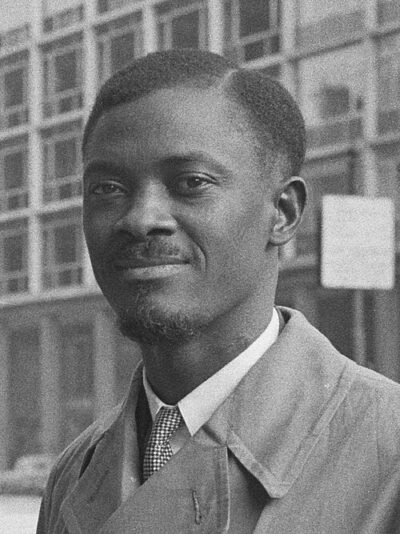
Patrice Lumumba
Patrice Lumumba was a Congolese politician and independence leader. Born July 2, 1925, in Katakokombe. Died January 17, 1961, in Lubumbashi. Positions held include Prime Minister of the Democratic Republic of the Congo (1960). Awards include Order of the Companions of O. R. Tambo and Grand Cross of the Order of the Crown.
Facts
21 facts · 2 confirmed by two sources · 2 cited · 17 from one source
Where this comes from
Papalocal keeps its own record. It started from these sources; what each one said is kept here as it was copied, so a change on their side never changes this page by itself. Tap one to read its version.
What Wikidata says · copied November 16, 2026 · revision 2562763900
- Described as
- Congolese politician and independence leader (1925–1961)
- Other names
- Patrice Emery Lumumba, Isaïe Tasumbu Tawosa, Élias Okit'Asombo
- Born
- July 2, 1925 · 9 references
- Died
- January 17, 1961 · 7 references
- Born in
- Katakokombe
- Died in
- Lubumbashi
- Buried in
- Mausoleum of Patrice Lumumba
- Cause of death
- execution by shooting
- Citizen of
- Republic of the Congo (Léopoldville)
- Occupation
- revolutionary; founder · 1 reference; politician · 1 reference
- Positions held
- Prime Minister of the Democratic Republic of the Congo (1960)
- Political party
- Mouvement National Congolais (1958–); Liberal Party (1955–1958)
- Awards
- Order of the Companions of O. R. Tambo (2004); Grand Cross of the Order of the Crown (1960) · 1 reference
- Spouse
- Pauline Opango
- Children
- François Lumumba; Guy-Patrice Lumumba; Juliane Amato Lumumba; Roland Lumumba
- Religion
- Catholic Church
- Wikipedias with a page
- 114
Wikidata item Q161672 (wikidata.org/wiki/Q161672), public domain (CC0). Copied November 16, 2026.
What Wikipedia says · copied November 16, 2026 · revision 1381850031
Patrice Émery Lumumba ( pə-TREESS luu-MUUM-bə; born Isaïe Tasumbu Tawosa; 2 July 1925 – 17 January 1961) was a Congolese politician, independence leader, and revolutionary who served as the first prime minister of the First Congolese Republic (modern day Democratic Republic of the Congo) from June until September 1960, following his party's success in the May 1960 election. Lumumba was the leader of the Congolese National Movement (MNC) from 1958 until his assassination in 1961. Ideologically an African nationalist and pan-Africanist, he played a significant role in the transformation of the Congo from a colony of Belgium into an independent republic.
Shortly after Congolese independence in June 1960, an army mutiny marked the beginning of the Congo Crisis. Both Katanga and South Kasai declared independence, which Lumumba responded to by sending the Congolese army to put down the secessions. This created a political crisis that resulted in then President Joseph Kasa-Vubu dismissing Lumumba and his government. This was followed by a coup led by Mobutu Sese Seko. Lumumba attempted to escape to Stanleyville to join his supporters who had established a new anti-Mobutu state called the Free Republic of the Congo, but he was captured by state authorities under Mobutu, and sent to Elisabethville in Katanga. He was tortured and later executed by the separatist Katangan authorities of Moïse Tshombe, alongside Belgian mercenaries. His body was later dissolved in acid. In 2002, Belgium formally apologised for its role in the execution, admitting "moral responsibility". In 2022, Lumumba's tooth was returned by the Belgian government to his family.
Lumumba is widely seen as a martyr for anti-colonial liberation and the pan-African movement.
- Born, in its opening lines
- July 2, 1925
- Died, in its opening lines
- January 17, 1961
From the Wikipedia article “Patrice Lumumba” (en.wikipedia.org/wiki/Patrice_Lumumba), by its contributors, under CC BY-SA 4.0 (creativecommons.org/licenses/by-sa/4.0/). Copied November 16, 2026; not changed.
Confirmed Two sources agree. Cited One source, and it names where it got it. One source One source, without a reference of its own. Sources disagree The sources disagree. We show the best-supported value and keep theirs below.
