
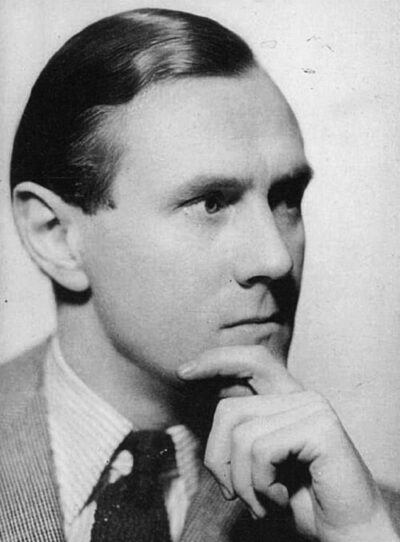
Patrick White
Patrick White was an English-born Australian writer. Born May 28, 1912, in London. Died September 30, 1990, in Sydney. Known for Voss. Educated at Cheltenham College and King's College. Awards include Nobel Prize in Literature, Miles Franklin Literary Award (2 times) and Australian of the Year.
Facts
23 facts · 2 confirmed by two sources · 5 cited · 16 from one source
Where this comes from
Papalocal keeps its own record. It started from these sources; what each one said is kept here as it was copied, so a change on their side never changes this page by itself. Tap one to read its version.
What Wikidata says · copied November 16, 2026 · revision 2563065419
- Described as
- English-born Australian writer
- Other names
- Alex Xenophon Demirjian Gray, Patrick Victor Martindale White
- Born
- May 28, 1912 · 9 references
- Died
- September 30, 1990 · 7 references
- Born in
- London · 1 reference
- Died in
- Sydney · 2 references
- Name at birth
- Patrick Victor Martindale White
- Citizen of
- Australia
- Occupation
- writer · 1 reference; novelist; playwright · 1 reference; poet; screenwriter; autobiographer
- Education
- Cheltenham College; King's College; The King's School, Tudor House
- Genre
- prose
- Known for
- Voss
- Awards
- Nobel Prize in Literature (1973) · 2 references; Miles Franklin Literary Award (2 times) (1957, 1961); Australian of the Year (1973); Companion of the Order of Australia
- Field
- prose · 1 reference
- Military branch
- Royal Air Force
- Wikipedias with a page
- 92
Wikidata item Q129187 (wikidata.org/wiki/Q129187), public domain (CC0). Copied November 16, 2026.
What Wikipedia says · copied November 16, 2026 · revision 1381980546
Patrick Victor Martindale White (28 May 1912 – 30 September 1990) was an Australian novelist and playwright who explored themes of religious experience, personal identity and the conflict between visionary individuals and a materialistic, conformist society. Influenced by the modernism of James Joyce, D. H. Lawrence and Virginia Woolf, he developed a complex literary style and a body of work that challenged the dominant realist prose tradition of his home country, was satirical of Australian society, and sharply divided local critics. He was awarded the Nobel Prize in Literature in 1973 and is the only Australian to receive it.
Born in London to affluent Australian parents, White spent his childhood in Sydney and on his family's rural properties. He was sent to an English public school at the age of 13, and went on to read modern languages at Cambridge. After graduating in 1935 he embarked on a literary career. His first published novel, Happy Valley (1939), was awarded the Gold Medal of the Australian Literature Society. In World War II he served as an intelligence officer in the Royal Air Force. While stationed in Alexandria, Egypt, in 1941, he met Manoly Lascaris, who became his life companion and, as White later wrote, "the central mandala in my life's hitherto messy design."
In 1948 White returned to Australia, where he bought a small farm on the outskirts of Sydney. There he wrote the two novels, The Tree of Man (1955) and Voss (1957), that brought him critical acclaim in the United States and the United Kingdom. In the 1960s he wrote the novels Riders in the Chariot (1961) and The Solid Mandala (1966), and a series of plays, including The Season at Sarsaparilla and A Cheery Soul, that had a major impact on Australian theatre.
White and Lascaris moved to Sydney's Centennial Park in 1964. From the late 1960s White became increasingly involved in public affairs, opposing the Vietnam War and supporting Aboriginal self-determination, nuclear disarmament and environmental causes. His later work includes the novels The Eye of the Storm (1973) and The Twyborn Affair (1979) and the memoir Flaws in the Glass (1981).
- Born, in its opening lines
- May 28, 1912
- Died, in its opening lines
- September 30, 1990
From the Wikipedia article “Patrick White” (en.wikipedia.org/wiki/Patrick_White), by its contributors, under CC BY-SA 4.0 (creativecommons.org/licenses/by-sa/4.0/). Copied November 16, 2026; not changed.
Confirmed Two sources agree. Cited One source, and it names where it got it. One source One source, without a reference of its own. Sources disagree The sources disagree. We show the best-supported value and keep theirs below.
