
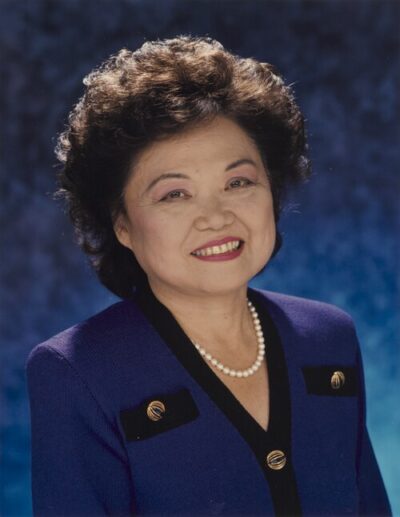
Patsy Mink
Patsy Mink was an American politician. Born December 6, 1927, in Paia. Died September 28, 2002, in Honolulu. Positions held include Assistant Secretary of State for Oceans and International Environmental and Scientific Affairs (1977–1978), member of the Hawaii House of Representatives (1956–1958) and member of the State Senate of Hawaii (1962–1964). Educated at University of Nebraska–Lincoln and University of Hawaiʻi at Mānoa. Awards include National Women's Hall of Fame, Presidential Medal of Freedom and Margaret Brent Award.
Facts
28 facts · 2 confirmed by two sources · 19 cited · 7 from one source
Where this comes from
Papalocal keeps its own record. It started from these sources; what each one said is kept here as it was copied, so a change on their side never changes this page by itself. Tap one to read its version.
What Wikidata says · copied November 16, 2026 · revision 2566937232
- Described as
- American politician (1927–2002)
- Other names
- Patsy Matsu Takemoto Mink, Patsy T. Mink, Patsy Matsu Takemoto, Patsy Matsu Mink, Patsy Takemoto Mink
- Born
- December 6, 1927 · 2 references
- Died
- September 28, 2002 · 2 references
- Born in
- Paia
- Died in
- Honolulu · 1 reference
- Buried in
- National Memorial Cemetery of the Pacific · 1 reference
- Cause of death
- pneumonia
- Citizen of
- United States
- Occupation
- politician · 1 reference; lawyer · 1 reference; lecturer (1952–1956) · 1 reference
- Positions held
- Assistant Secretary of State for Oceans and International Environmental and Scientific Affairs (1977–1978); member of the Hawaii House of Representatives (1956–1958) · 1 reference; member of the State Senate of Hawaii (1962–1964) · 1 reference; delegate (–1960) · 1 reference; president (1978–1981) · 1 reference; member (1983–1987) · 1 reference; United States representative (2 times) (1965–2002) · 2 references
- Political party
- Democratic Party
- Education
- University of Nebraska–Lincoln (–1947) · 1 reference; University of Hawaiʻi at Mānoa (–1948) · 1 reference; University of Chicago Law School (–1951) · 1 reference; Maui High School (–1944) · 2 references; Wilson College (–1946) · 1 reference
- Awards
- National Women's Hall of Fame (2003) · 1 reference; Presidential Medal of Freedom (2014) · 1 reference; Margaret Brent Award (1992) · 1 reference
- Children
- Gwendolyn Mink
- Religion
- Congregational churches
- Wikipedias with a page
- 24
Wikidata item Q399235 (wikidata.org/wiki/Q399235), public domain (CC0). Copied November 16, 2026.
What Wikipedia says · copied November 16, 2026 · revision 1384161840
Patsy Matsu Mink (née Takemoto; December 6, 1927 – September 28, 2002) was an American attorney and politician from the U.S. state of Hawaii who served in the United States House of Representatives for 24 years as a member of the Democratic Party, initially from 1965 to 1977, and again from 1990 until her death in 2002. She was the first Woman of Color and first Asian-American woman elected to Congress, and is known for her work on legislation advancing women's rights and education.
Mink was a third-generation Japanese American, having been born and raised on the island of Maui. After graduating as valedictorian of the Maui High School class in 1944, she attended the University of Hawaiʻi at Mānoa for two years and subsequently enrolled at the University of Nebraska, where she experienced racism and worked to have segregation policies eliminated. After illness forced her to return to Hawaii to complete her studies there, she applied to 12 medical schools to continue her education but was rejected by all of them. Following a suggestion by her employer, she opted to study law and was accepted at the University of Chicago Law School in 1948. While there, she met and married a graduate student in geology, John Francis Mink. When they graduated in 1951, Patsy was unable to find employment and after the birth of their daughter in 1952, the couple moved to Hawaii.
When she was refused the right to take the bar examination, due to the loss of her Hawaiian territorial residency upon marriage, Mink challenged the statute. Though she won the right to take the test and passed the examination, she could not find public or private employment because she was married and had a child. Mink's father helped her open her own practice in 1953 and around the same time she became a member of the Democratic Party. Hoping to work legislatively to change discriminatory customs through law, she worked as an attorney for the Hawaiian territorial legislature in 1955. The following year, she ran for a seat in the territorial House of Representatives. Winning the race, she became the first Japanese-American woman to serve in the territorial House and two years later, the first woman to serve in the territorial Senate, when she won her campaign for the upper house. In 1960, Mink gained national attention when she spoke in favor of the civil rights platform at the Democratic National Convention in Los Angeles. In 1962 she was elected to the new Hawaii State Senate becoming the first Asian-American woman to be elected and serve in a state legislature in the United States.
In 1964, Mink ran for federal office and won a seat in the U.S. House of Representatives. She served a total of 12 terms (24 years), split between representing Hawaii's at-large congressional district from 1965 to 1977 and second congressional district from 1990 to 2002. While in Congress in the late 1960s, she introduced the first comprehensive initiatives under the Early Childhood Education Act, which included the first federal child-care bill and worked on the Elementary and Secondary Education Act of 1965. In 1970, she became the first person to oppose a Supreme Court nominee on the basis of discrimination against women. Mink initiated a lawsuit which led to significant changes to presidential authority under the Freedom of Information Act in 1971. In 1972, she co-authored the Title IX Amendment of the Higher Education Act, later renamed the Patsy T. Mink Equal Opportunity in Education Act in 2002.
Mink was the first East Asian-American woman to seek the presidential nomination of the Democratic Party. She ran in the 1972 election, entering the Oregon primary as an anti-war candidate. She was the federal Assistant Secretary of State for Oceans and International Environmental and Scientific Affairs from 1977 to 1979. From 1980 to 1982, Mink served as the president of Americans for Democratic Action and then returned to Honolulu, where she was elected to the Honolulu City Council, which she chaired until 1985. In 1990, she was again elected to the U.S. House, serving until her death in 2002.
- Born, in its opening lines
- December 6, 1927
- Died, in its opening lines
- September 28, 2002
From the Wikipedia article “Patsy Mink” (en.wikipedia.org/wiki/Patsy_Mink), by its contributors, under CC BY-SA 4.0 (creativecommons.org/licenses/by-sa/4.0/). Copied November 16, 2026; not changed.
Confirmed Two sources agree. Cited One source, and it names where it got it. One source One source, without a reference of its own. Sources disagree The sources disagree. We show the best-supported value and keep theirs below.
