
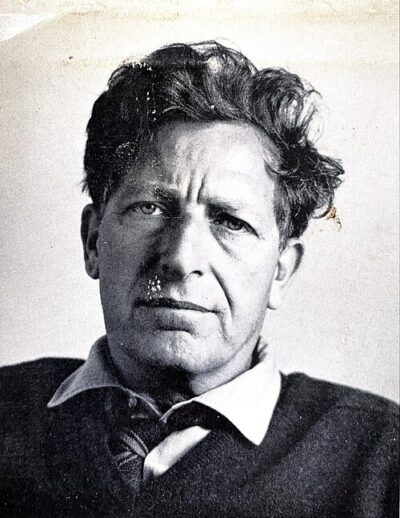
Paul Goodman
Paul Goodman was an American writer and public intellectual. Born September 9, 1911, in Greenwich Village. Died August 2, 1972, in North Stratford. Educated at University of Chicago and City College of New York.
Facts
19 facts · 2 confirmed by two sources · 8 cited · 9 from one source
Where this comes from
Papalocal keeps its own record. It started from these sources; what each one said is kept here as it was copied, so a change on their side never changes this page by itself. Tap one to read its version.
What Wikidata says · copied November 15, 2026 · revision 2558206831
- Described as
- American writer and public intellectual (1911–1972)
- Born
- September 9, 1911 · 5 references
- Died
- August 2, 1972 · 5 references
- Born in
- Greenwich Village
- Died in
- North Stratford · 1 reference
- Buried in
- Stratford Center Cemetery · 1 reference
- Citizen of
- United States
- Occupation
- writer · 1 reference; poet · 1 reference; psychotherapist; novelist; sociologist · 3 references; literary critic · 3 references; LGBTQ rights activist · 1 reference; political scientist · 1 reference
- Worked for
- Sarah Lawrence College
- Education
- University of Chicago; City College of New York · 1 reference; Hebrew school
- Siblings
- Percival Goodman · 1 reference
- Wikipedias with a page
- 27
Wikidata item Q943567 (wikidata.org/wiki/Q943567), public domain (CC0). Copied November 15, 2026.
What Wikipedia says · copied November 15, 2026 · revision 1372806884
Paul Goodman (September 9, 1911 – August 2, 1972) was an American writer and public intellectual best known for his 1960s works of social criticism. Goodman was prolific across numerous literary genres and non-fiction topics, including the arts, civil rights, decentralization, democracy, education, media, politics, psychology, technology, urban planning, and war. As a humanist and self-styled man of letters, his works often addressed a common theme of the individual citizen's duties in the larger society, and the responsibility to exercise autonomy, act creatively, and realize one's own human nature.
Born to a Jewish family in New York City, Goodman was raised by his aunts and sister and attended City College of New York. As an aspiring writer, he wrote and published poems and fiction before receiving his doctorate from the University of Chicago. He returned to writing in New York City and took sporadic magazine writing and teaching jobs, several of which he lost for his overt bisexuality and his draft resistance during World War II. Goodman discovered anarchism and wrote for libertarian journals. His radicalism was rooted in psychological theory. He co-wrote the theory behind Gestalt therapy based on Wilhelm Reich's radical Freudianism and held psychoanalytic sessions through the 1950s while continuing to write prolifically.
His 1960 book of social criticism, Growing Up Absurd, established his importance as a mainstream, antiestablishment cultural theorist. Goodman became known as "the philosopher of the New Left" and his anarchistic disposition was influential in 1960s counterculture and the free school movement. Despite being the foremost American intellectual of non-Marxist radicalism in his time, his celebrity did not endure far beyond his life. Goodman is remembered for his utopian proposals and principled belief in human potential.
- Born, in its opening lines
- September 9, 1911
- Died, in its opening lines
- August 2, 1972
From the Wikipedia article “Paul Goodman” (en.wikipedia.org/wiki/Paul_Goodman), by its contributors, under CC BY-SA 4.0 (creativecommons.org/licenses/by-sa/4.0/). Copied November 15, 2026; not changed.
Confirmed Two sources agree. Cited One source, and it names where it got it. One source One source, without a reference of its own. Sources disagree The sources disagree. We show the best-supported value and keep theirs below.
