
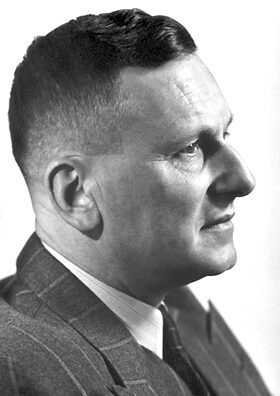
Paul Hermann Müller
Paul Hermann Müller was a Swiss chemist. Born January 12, 1899, in Olten. Died October 12, 1965, in Basel. Educated at University of Basel. Awards include Nobel Prize in Physiology or Medicine.
Facts
11 facts · 1 confirmed by two sources · 6 cited · 3 from one source · 1 where the sources disagree
What’s different
- Died: we show October 12, 1965 (Sources disagree). Wikipedia says October 13, 1965
Where this comes from
Papalocal keeps its own record. It started from these sources; what each one said is kept here as it was copied, so a change on their side never changes this page by itself. Tap one to read its version.
What Wikidata says · copied November 16, 2026 · revision 2569063004
- Described as
- Swiss chemist (1899-1965)
- Other names
- Paul Hermann Mueller
- Born
- January 12, 1899 · 8 references
- Died
- October 12, 1965 · 6 references
- Born in
- Olten · 5 references
- Died in
- Basel · 4 references
- Buried in
- Friedhof am Hörnli · 1 reference
- Citizen of
- Switzerland · 2 references
- Occupation
- chemist · 2 references; physician
- Education
- University of Basel (1919–) · 1 reference
- Awards
- Nobel Prize in Physiology or Medicine (1948) · 2 references
- Field
- malaria
- Wikipedias with a page
- 56
Wikidata item Q115475 (wikidata.org/wiki/Q115475), public domain (CC0). Copied November 16, 2026.
What Wikipedia says · copied November 16, 2026 · revision 1371982374
Paul Hermann Müller, also known as Pauly Mueller (12 January 1899 – 13 October 1965), was a Swiss chemist who received the 1948 Nobel prize in Physiology or Medicine for his 1939 discovery of insecticidal qualities and use of DDT in the control of vector diseases such as malaria and yellow fever.
- Born, in its opening lines
- January 12, 1899
- Died, in its opening lines
- October 13, 1965
From the Wikipedia article “Paul Hermann Müller” (en.wikipedia.org/wiki/Paul_Hermann_Müller), by its contributors, under CC BY-SA 4.0 (creativecommons.org/licenses/by-sa/4.0/). Copied November 16, 2026; not changed.
Confirmed Two sources agree. Cited One source, and it names where it got it. One source One source, without a reference of its own. Sources disagree The sources disagree. We show the best-supported value and keep theirs below.
