
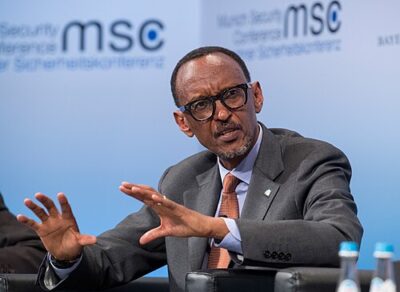
Paul Kagame
Paul Kagame is a President of Rwanda since 2000. Born October 23, 1957, in Ruhango. Positions held include President of Rwanda (2000–), Chairperson of the African Union (2018–2019) and Vice President of Rwanda (1994–2000). Educated at United States Army Command and General Staff College and Makerere University. Awards include Order of the Pioneers of Liberia, Order of the Republic of Serbia and Ribbon bar of the Kagera River Medal.
Facts
25 facts · 1 confirmed by two sources · 7 cited · 17 from one source
Where this comes from
Papalocal keeps its own record. It started from these sources; what each one said is kept here as it was copied, so a change on their side never changes this page by itself. Tap one to read its version.
What Wikidata says · copied November 16, 2026 · revision 2563039874
- Described as
- President of Rwanda since 2000 (born 1957)
- Other names
- Szanowny Paul Kagame, Jego Ekscelencja Paul Kagame, Paul Kagamé
- Born
- October 23, 1957 · 2 references
- Born in
- Ruhango · 1 reference
- Citizen of
- Rwanda · 2 references
- Occupation
- politician · 3 references; military officer; minister · 1 reference
- Positions held
- President of Rwanda (2000–); Chairperson of the African Union (2018–2019); Vice President of Rwanda (1994–2000); Minister of Defence (1994–2000)
- Political party
- Rwandan Patriotic Front · 1 reference
- Education
- United States Army Command and General Staff College; Makerere University · 1 reference
- Awards
- Order of the Pioneers of Liberia (2009) · 1 reference; Order of the Republic of Serbia; Ribbon bar of the Kagera River Medal; Grand Cross of the National Order of Benin (2010) · 1 reference
- Spouse
- Jeannette Kagame (1989–)
- Children
- Ange Kagame; Ian Kagame; Brian Kagame · 1 reference
- Religion
- Catholic Church
- Military branch
- Rwandan Defence Forces
- Military rank
- commander-in-chief
- Website
- http://paulkagame.com
- Wikipedias with a page
- 94
Wikidata item Q1231345 (wikidata.org/wiki/Q1231345), public domain (CC0). Copied November 16, 2026.
What Wikipedia says · copied November 16, 2026 · revision 1385936673
Paul Kagame (born 23 October 1957) is a Rwandan politician and former military officer who has been the president of Rwanda since 2000. He is considered to be Rwanda's de facto leader since 1994, from 1994 till 2000 while Vice President and Minister of Defence under President Pasteur Bizimungu. He was previously a commander of the Rwandan Patriotic Front (RPF), a rebel armed force which invaded Rwanda in 1990. The RPF was one of the main belligerents of the Rwandan Civil War and was the armed force which ended the 1994 Rwandan genocide.
Born to a Tutsi family in southern Rwanda that fled to Uganda when he was two years old, Kagame spent the rest of his childhood there during the Rwandan Revolution, which ended Tutsi political dominance. In the 1980s, Kagame fought in Yoweri Museveni's rebel army becoming a senior Ugandan army officer after many military victories led Museveni to the Ugandan presidency. Kagame joined the RPF, taking control of the group when previous leader Fred Rwigyema died on the second day of the 1990 invasion. By 1993, the RPF controlled significant territory in Rwanda and a ceasefire was negotiated. The assassination of Rwandan president Juvénal Habyarimana set off the genocide, in which Hutu extremists killed an estimated 500,000 to 800,000 Tutsi and moderate Hutu. Kagame resumed the civil war and ended the genocide with a military victory.
During his vice presidency, Kagame controlled the national army and was responsible for maintaining the government's power, while other officials began rebuilding the country. Many RPF soldiers carried out retribution killings. Kagame said he did not support these killings but failed to stop them. Hutu refugee camps formed in Zaire and other countries and the RPF attacked the camps in 1996, but insurgents continued to attack Rwanda. As part of the invasion, Kagame sponsored two rebel wars in Zaire. Rwandan- and Ugandan-backed rebels won the first war (1996–97), installing Laurent-Désiré Kabila as president in place of dictator Mobutu Sese Seko and returning Zaire to its former pre-Mobutu name, the Democratic Republic of the Congo (DRC). The second war was launched in 1998 against Kabila, and later his son Joseph, following the DRC government's expulsion of Rwandan and Ugandan military forces from the country. The war escalated into a conflict that lasted until a 2003 peace deal and ceasefire.
Bizimungu resigned in 2000, most likely having been forced to do so, following a falling out with the RPF. He was replaced by Kagame. Bizimungu was later imprisoned for corruption and inciting ethnic violence, charges that human rights groups described as politically motivated. Kagame's rule is considered authoritarian, and human rights groups accuse him of political repression. Overall opinion on the regime by foreign observers is mixed, and as president, Kagame has prioritised national development, launching programmes which have led to development on key indicators including healthcare, education and economic growth. Kagame has had mostly good relations with the East African Community and the United States; his relations with France were poor until 2009. Relations with the DRC remain tense despite the 2003 ceasefire; human rights groups and a leaked United Nations report allege Rwandan support for two insurgencies in the country, a charge Kagame denies. Several countries suspended aid payments in 2012 following these allegations. Since coming to power, Kagame has won four presidential elections, but none of these have been rated free or fair by international observers. His role in the assassination of exiled political opponents has been controversial.
- Born, in its opening lines
- October 23, 1957
From the Wikipedia article “Paul Kagame” (en.wikipedia.org/wiki/Paul_Kagame), by its contributors, under CC BY-SA 4.0 (creativecommons.org/licenses/by-sa/4.0/). Copied November 16, 2026; not changed.
Confirmed Two sources agree. Cited One source, and it names where it got it. One source One source, without a reference of its own. Sources disagree The sources disagree. We show the best-supported value and keep theirs below.
