
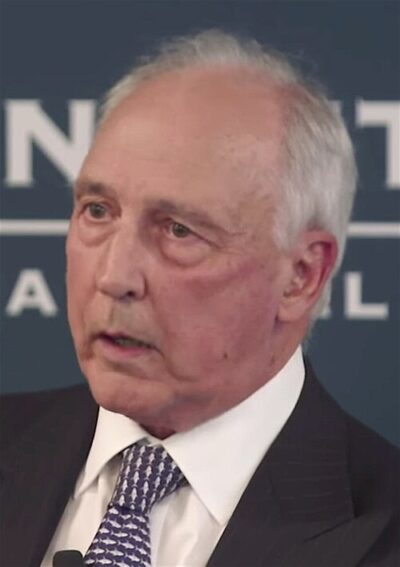
Paul Keating
Paul Keating is an Australian politician, 24th Prime Minister of Australia. Born January 18, 1944, in Bankstown. Positions held include Prime Minister of Australia (1991–1996), member of the Australian House of Representatives (1969–1996) and Deputy Prime Minister of Australia (1990–1991). Educated at LaSalle Catholic College, Bankstown. Awards include Australian National Living Treasure and doctor honoris causa of Keiō University.
Facts
22 facts · 1 confirmed by two sources · 2 cited · 19 from one source
Where this comes from
Papalocal keeps its own record. It started from these sources; what each one said is kept here as it was copied, so a change on their side never changes this page by itself. Tap one to read its version.
What Wikidata says · copied November 16, 2026 · revision 2562815242
- Described as
- Australian politician, 24th Prime Minister of Australia
- Other names
- Paul John Keating, The Honourable Paul Keating
- Born
- January 18, 1944 · 5 references
- Born in
- Bankstown
- Citizen of
- Australia
- Occupation
- politician · 1 reference; trade unionist; head of government · 1 reference
- Positions held
- Prime Minister of Australia (1991–1996); member of the Australian House of Representatives (1969–1996); Deputy Prime Minister of Australia (1990–1991); Treasurer of Australia (1983–1991); Minister for Home Affairs (1975)
- Political party
- Australian Labor Party
- Worked for
- University of New South Wales
- Education
- LaSalle Catholic College, Bankstown
- Awards
- Australian National Living Treasure; doctor honoris causa of Keiō University
- Spouse
- Annita van Iersel (1975–2008)
- Children
- Katherine Keating
- Religion
- Catholic Church; Catholicism
- Lived in
- Potts Point
- Website
- http://www.keating.org.au
- Wikipedias with a page
- 57
Wikidata item Q242654 (wikidata.org/wiki/Q242654), public domain (CC0). Copied November 16, 2026.
What Wikipedia says · copied November 16, 2026 · revision 1384237977
Paul John Keating (born 18 January 1944) is an Australian former politician and trade unionist who served as the 24th prime minister of Australia and leader of the Labor Party from 1991 to 1996. He previously served as treasurer from 1983 to 1991 and as deputy prime minister from 1990 to 1991 under the prime ministership of Bob Hawke.
Born in Sydney, Keating left school at the age of 14. He joined the Labor Party at the same age, serving a term as State president of Young Labor and working as a research assistant for a trade union. He was elected to the Australian House of Representatives at the age of 25, winning the division of Blaxland at the 1969 federal election. He was briefly minister for Northern Australia from October to November 1975, in the final weeks of the Whitlam government - along with Doug McClelland, he is the last surviving minister who served under Gough Whitlam. After the Dismissal removed Labor from power, he held senior portfolios in the Shadow Cabinets of Whitlam and Bill Hayden. During this time he came to be seen as the leader of the Labor Right faction, and developed a reputation as a talented and fierce parliamentary performer.
After Labor's landslide victory at the 1983 election, Keating was appointed treasurer by prime minister Bob Hawke. The pair developed a powerful political partnership, overseeing significant reforms intended to liberalise and strengthen the Australian economy. These included the Prices and Incomes Accord, the float of the Australian dollar, the elimination of tariffs, the deregulation of the financial sector, achieving the first federal budget surplus in Australian history, and reform of the taxation system, including the introduction of capital gains tax, fringe benefits tax, and dividend imputation. He also became recognised for his sardonic rhetoric, as a controversial but deeply skilled orator. Keating became deputy prime minister in 1990, but in June 1991 he resigned from the ministry to unsuccessfully challenge Hawke for the leadership, believing he had reneged on the Kirribilli Agreement. He mounted a second successful challenge six months later, and became prime minister.
Keating was appointed prime minister in the aftermath of the early 1990s economic downturn, which he had famously described as "the recession that Australia had to have". This, combined with poor opinion polling, led many to predict Labor was certain to lose the 1993 election, but Keating's government was re-elected in an upset victory. In its second term, the Keating government enacted the landmark Native Title Act to enshrine Indigenous land rights, introduced compulsory superannuation and enterprise bargaining, created a national infrastructure development program, privatised Qantas, Commonwealth Serum Laboratories and the Commonwealth Bank, established the APEC leaders' meeting, and promoted republicanism by establishing the Republic Advisory Committee.
At the 1996 election, after 13 years in office, Keating's government suffered a landslide defeat to the Liberal–National Coalition, led by John Howard. Keating resigned as leader of the Labor Party and retired from Parliament shortly after the election, with his deputy Kim Beazley being elected unopposed to replace him. Keating has since remained active as a political commentator, whilst maintaining a broad series of business interests, including serving on the international board of the China Development Bank from 2005 to 2018. He has been critical of Labor Party policy such as AUKUS and urged closer relations with China and other countries in the Indo-Pacific region.
As prime minister, Keating performed poorly in opinion polls, and in August 1993, received the lowest approval rating for any Australian prime minister since modern political polling began. Since leaving office, Keating received broad praise from historians and commentators for his role in modernising the Australian economy as treasurer, although ratings of his premiership have been mixed. Keating has been recognised across the political spectrum for his charisma, debating skills, and his willingness to boldly confront social norms, including his famous Redfern Park Speech on the impact of colonisation in Australia and Aboriginal reconciliation.
- Born, in its opening lines
- January 18, 1944
From the Wikipedia article “Paul Keating” (en.wikipedia.org/wiki/Paul_Keating), by its contributors, under CC BY-SA 4.0 (creativecommons.org/licenses/by-sa/4.0/). Copied November 16, 2026; not changed.
Confirmed Two sources agree. Cited One source, and it names where it got it. One source One source, without a reference of its own. Sources disagree The sources disagree. We show the best-supported value and keep theirs below.
