
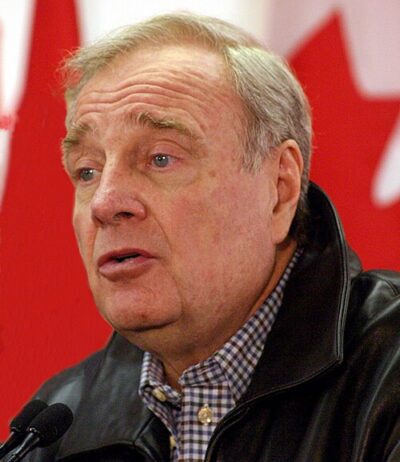
Paul Martin
Paul Martin is a prime minister of Canada from 2003 to 2006. Born August 28, 1938, in Windsor. Positions held include Prime Minister of Canada (2003–2006), Minister of Finance (1993–2002) and Minister responsible for the Economic Development Agency of Canada for the Regions of Quebec (1993–1996). Educated at University of St. Michael's College and Henry N.R. Jackman Faculty of Law. Awards include Companion of the Order of Canada, honorary doctorate at the Laval University and Honorary doctor of the University of Ottawa.
Facts
25 facts · 1 confirmed by two sources · 6 cited · 18 from one source
Where this comes from
Papalocal keeps its own record. It started from these sources; what each one said is kept here as it was copied, so a change on their side never changes this page by itself. Tap one to read its version.
What Wikidata says · copied November 13, 2026 · revision 2567279199
- Described as
- prime minister of Canada from 2003 to 2006
- Other names
- Paul Martin, Jr., Paul Edgar Philippe Martin
- Born
- August 28, 1938 · 5 references
- Born in
- Windsor
- Name at birth
- Paul Edgar Philippe Martin
- Citizen of
- Canada
- Occupation
- politician · 1 reference; lawyer · 1 reference; entrepreneur; businessperson · 1 reference
- Positions held
- Prime Minister of Canada (2003–2006); Minister of Finance (1993–2002) · 1 reference; Minister responsible for the Economic Development Agency of Canada for the Regions of Quebec (1993–1996); Leader of the Liberal Party of Canada (2003–2006); member of the House of Commons of Canada (1988–2008) · 1 reference
- Political party
- Liberal Party of Canada
- Education
- University of St. Michael's College; Henry N.R. Jackman Faculty of Law
- Awards
- Companion of the Order of Canada; honorary doctorate at the Laval University · 1 reference; Honorary doctor of the University of Ottawa; Canadian Newsmaker of the Year (2003)
- Spouse
- Sheila Martin
- Father
- Paul Joseph James Martin
- Religion
- Catholicism
- Lived in
- Montreal
- Height
- 1.88 m (6 ft 2 in) · 1 reference
- Wikipedias with a page
- 65
Wikidata item Q128529 (wikidata.org/wiki/Q128529), public domain (CC0). Copied November 13, 2026.
What Wikipedia says · copied November 13, 2026 · revision 1383192787
Paul Edgar Philippe Martin (French: [pɔl maʁtɛ̃]; born August 28, 1938), also known as Paul Martin Jr., is a Canadian lawyer and retired politician who served as the 21st prime minister of Canada and the leader of the Liberal Party of Canada from 2003 to 2006.
The son of former senator and secretary of state for external affairs Paul Martin Sr., Martin was born in Windsor, Ontario and was a lawyer from Ontario before he became president and chief executive officer of Canada Steamship Lines in 1973. He held that position until his election as a member of Parliament for the Montreal riding of LaSalle—Émard in 1988. Martin ran for leader of the Liberal Party in 1990, losing to Jean Chrétien. Martin became Chrétien's longtime rival for the leadership of the party, though he was appointed as minister of finance after the Liberal victory in the 1993 federal election. As minister, Martin oversaw many changes in the financial structure of the Canadian government, and his policies had a direct effect on eliminating the country's chronic fiscal deficit by sharply cutting spending and reforming programs. In 2002, he was removed as finance minister as tensions with Chrétien reached their peak. Martin initially prepared to challenge Chrétien's leadership, but when Chrétien announced his intention to retire, Martin entered the 2003 Liberal Party of Canada leadership election. Martin won the leadership in a landslide and was sworn in as prime minister that December.
Martin led the Liberal Party in the 2004 federal election, in which the party retained power as a minority government, losing its majority amid the sponsorship scandal, which had begun to develop in the late 1990s. After the election, Martin's government signed the Kelowna Accord to improve the living conditions of Indigenous peoples and legalized same-sex marriage through the Civil Marriage Act. In 2005, after the Gomery Commission released new details about the sponsorship scandal, opposition parties in the House of Commons passed a motion of no confidence alleging government corruption, triggering the 2006 federal election. In that election, Martin's Liberals were defeated by the newly unified Conservative Party led by Stephen Harper, ending over 12 years of Liberal rule.
Shortly after the defeat, Martin stepped down as Liberal leader and declined to seek re-election in 2008. Evaluations of Martin's prime ministership have been mixed, whereas his tenure as finance minister has been viewed more favourably. Martin has participated in international initiatives, including Incentives for Global Health and the not-for-profit organization behind the Health Impact Fund, on whose advisory board he serves. He also sits as an adviser to Canada's Ecofiscal Commission.
- Born, in its opening lines
- August 28, 1938
From the Wikipedia article “Paul Martin” (en.wikipedia.org/wiki/Paul_Martin), by its contributors, under CC BY-SA 4.0 (creativecommons.org/licenses/by-sa/4.0/). Copied November 13, 2026; not changed.
Confirmed Two sources agree. Cited One source, and it names where it got it. One source One source, without a reference of its own. Sources disagree The sources disagree. We show the best-supported value and keep theirs below.
