
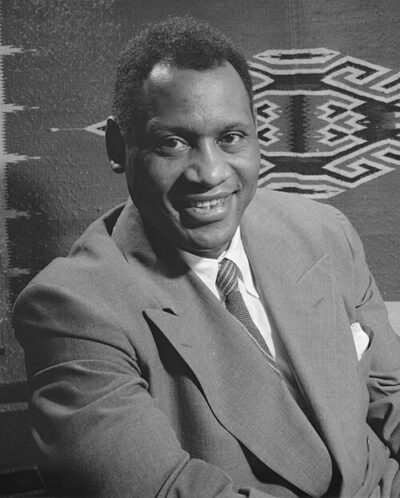
Paul Robeson
Paul Robeson was an American singer, actor, and political activist. Born April 9, 1898, in Princeton. Died January 23, 1976, in Philadelphia. Teams include Akron Pros. Educated at Rutgers University–New Brunswick and Columbia Law School. Awards include Spingarn Medal, Grammy Lifetime Achievement Award and New Jersey Hall of Fame.
Facts
44 facts · 2 confirmed by two sources · 13 cited · 29 from one source
Where this comes from
Papalocal keeps its own record. It started from these sources; what each one said is kept here as it was copied, so a change on their side never changes this page by itself. Tap one to read its version.
What Wikidata says · copied November 13, 2026 · revision 2565534738
- Described as
- American singer, actor, and political activist (1898–1976)
- Other names
- Paul Leroy Robeson
- Born
- April 9, 1898 · 12 references
- Died
- January 23, 1976 · 12 references
- Born in
- Princeton · 4 references
- Died in
- Philadelphia · 3 references
- Buried in
- Ferncliff Cemetery · 1 reference
- Cause of death
- stroke · 1 reference
- Citizen of
- United States
- Occupation
- singer · 2 references; lawyer; activist; basketball player; American football player · 1 reference; film actor; stage actor; actor · 2 references
- Political party
- Progressive Party
- Education
- Rutgers University–New Brunswick; Columbia Law School; SOAS, University of London; Somerville High School · 1 reference
- Member of
- Alpha Phi Alpha; Phi Beta Kappa Society
- Teams
- Akron Pros
- Sport
- American football · 1 reference
- Genre
- folk music
- Instrument
- voice
- Record label
- Columbia Records; Philips Records; His Master's Voice
- Awards
- Spingarn Medal (1945) · 1 reference; Grammy Lifetime Achievement Award (1998); New Jersey Hall of Fame (2009) · 1 reference; International Stalin Prize for Peace; Black Filmmakers Hall of Fame (1974); Paul Robeson Award (1974); star on Hollywood Walk of Fame · 1 reference; Donaldson Awards
- Spouse
- Eslanda Goode Robeson (1921–1965) · 1 reference
- Children
- Paul Robeson, Jr. · 1 reference
- Father
- William Drew Robeson I
- Mother
- Maria Louisa Bustill
- Military branch
- International Brigades
- Lived in
- Paul Robeson House (1965–1976) · 1 reference
- Height
- 1.91 m (6 ft 3 in)
- Wikipedias with a page
- 55
Wikidata item Q273233 (wikidata.org/wiki/Q273233), public domain (CC0). Copied November 13, 2026.
What Wikipedia says · copied November 13, 2026 · revision 1385553395
Paul Leroy Robeson ( ROHB-sən; April 9, 1898 – January 23, 1976) was an American bass-baritone concert artist, actor, professional football player, and activist who became famous both for his cultural accomplishments and for his political stances.
In 1915, Robeson won an academic scholarship to Rutgers College in New Brunswick, New Jersey, where he was the only African-American student. While at Rutgers, he was twice named a consensus All-American in football and was elected class valedictorian. He earned his LLB degree from Columbia Law School while playing in the National Football League (NFL). After graduation, he became a figure in the Harlem Renaissance, with performances in Eugene O'Neill's The Emperor Jones and All God's Chillun Got Wings.
Robeson performed in Britain in the touring melodrama Voodoo in 1922, and in Emperor Jones in 1925. In 1928, he scored a major success in the London premiere of Show Boat. Living in London for several years with his wife Eslanda, Robeson continued to establish himself as a concert artist, and he starred in a London production of Othello, the first of three productions of the play over the course of his career. He also gained attention in Sanders of the River (1935) and in the film production of Show Boat (1936).
Robeson's political activities began with his involvement with unemployed workers and anti-imperialist students in Britain, and it continued with his support for the Republican cause during the Spanish Civil War, the Soviet Union and Joseph Stalin, and his involvement in the Council on African Affairs.
During the Second World War, Robeson initially opposed Allied war efforts and U.S. entry into the conflict during the Molotov–Ribbentrop Pact, but he became a highly vocal supporter of the war efforts after the German invasion of the Soviet Union. His history of supporting Soviet policies brought scrutiny from the Federal Bureau of Investigation (FBI). After the war, the Council on African Affairs was placed on the Attorney General's List of Subversive Organizations. Robeson was investigated during the McCarthy era. When he refused to recant his public advocacy for the Soviet Union, the U.S. State Department withdrew his passport, and his income plummeted. He moved to Harlem and published a periodical called Freedom, which was critical of United States policies, from 1950 to 1955. Robeson's right to travel was eventually restored as a result of the 1958 United States Supreme Court decision Kent v. Dulles.
Between 1925 and 1961, Robeson released recordings of about 270 songs. The first of these was the spiritual "Steal Away", backed with "Were You There", in 1925. Robeson's recorded repertoire spanned many styles, including Americana, popular standards, classical music, European folk songs, political songs, poetry, and spoken excerpts from plays.
- Born, in its opening lines
- April 9, 1898
- Died, in its opening lines
- January 23, 1976
From the Wikipedia article “Paul Robeson” (en.wikipedia.org/wiki/Paul_Robeson), by its contributors, under CC BY-SA 4.0 (creativecommons.org/licenses/by-sa/4.0/). Copied November 13, 2026; not changed.
Confirmed Two sources agree. Cited One source, and it names where it got it. One source One source, without a reference of its own. Sources disagree The sources disagree. We show the best-supported value and keep theirs below.
