
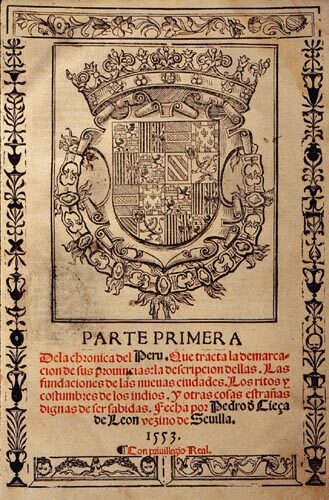
Pedro Cieza de León was a Spanish conquistador. Born 1518, in Llerena. Died July 2, 1554, in Seville.
Facts
17 facts · 0 confirmed by two sources · 8 cited · 9 from one source
Where this comes from
Papalocal keeps its own record. It started from these sources; what each one said is kept here as it was copied, so a change on their side never changes this page by itself. Tap one to read its version.
What Wikidata says · copied November 18, 2026 · revision 2567351831
- Described as
- Spanish conquistador
- Other names
- Pedro de Cieza de León
- Born
- 1518 · 3 references
- Died
- July 2, 1554 · 2 references
- Born in
- Llerena · 1 reference
- Died in
- Seville · 1 reference
- Citizen of
- Spain
- Occupation
- explorer; historian · 1 reference; Conqueror · 1 reference; chronicler · 1 reference; writer
- Field
- geography · 1 reference; ethnography · 1 reference; politics · 1 reference; botany · 1 reference; zoology · 1 reference; historiography · 1 reference
- Religion
- Catholic Church
- Wikipedias with a page
- 21
Wikidata item Q729597 (wikidata.org/wiki/Q729597), public domain (CC0). Copied November 18, 2026.
What Wikipedia says · copied November 18, 2026 · revision 1379392001
Pedro Cieza de León (Llerena, Spain c. 1518 or 1520 – Seville, 2 July 1554) was a Spanish conquistador and chronicler of Peru and Popayán. He is known primarily for his extensive work, Crónicas del Perú (The Chronicle of Peru), which has been described as "fundamental to an understanding of Inca history, as he was the first to consider the structure and organization of the Inca Empire." He wrote this book in four parts, but only the first was published during his lifetime; the remaining sections were not published until the 19th and 20th centuries.
From the Wikipedia article “Pedro Cieza de León” (en.wikipedia.org/wiki/Pedro_Cieza_de_León), by its contributors, under CC BY-SA 4.0 (creativecommons.org/licenses/by-sa/4.0/). Copied November 18, 2026; not changed.
Confirmed Two sources agree. Cited One source, and it names where it got it. One source One source, without a reference of its own. Sources disagree The sources disagree. We show the best-supported value and keep theirs below.
