
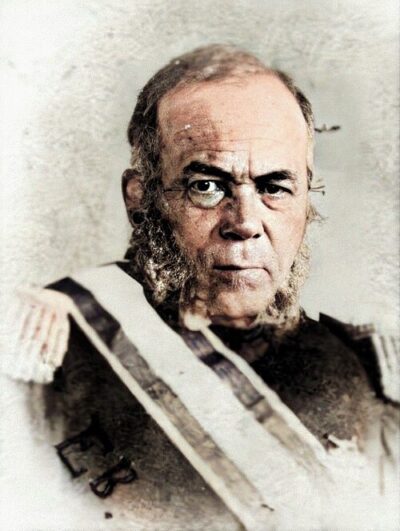
Pedro Santana
Pedro Santana was a President of the Dominican Republic. Born June 29, 1801, in Hinche. Died June 14, 1864, in Santo Domingo. Positions held include President of the Dominican Republic.
Facts
9 facts · 2 confirmed by two sources · 1 cited · 6 from one source
Where this comes from
Papalocal keeps its own record. It started from these sources; what each one said is kept here as it was copied, so a change on their side never changes this page by itself. Tap one to read its version.
What Wikidata says · copied November 18, 2026 · revision 2563044910
- Described as
- President of the Dominican Republic
- Born
- June 29, 1801
- Died
- June 14, 1864
- Born in
- Hinche
- Died in
- Santo Domingo
- Buried in
- Dominican National Pantheon
- Citizen of
- Dominican Republic
- Occupation
- politician · 1 reference
- Positions held
- President of the Dominican Republic
- Religion
- Catholic Church
- Wikipedias with a page
- 22
Wikidata item Q887185 (wikidata.org/wiki/Q887185), public domain (CC0). Copied November 18, 2026.
What Wikipedia says · copied November 18, 2026 · revision 1383515217
Pedro Santana y Familias, 1st Marquess of Las Carreras (June 29, 1801 – June 14, 1864) was a Dominican soldier and politician who served three times as the president of the First Dominican Republic (1844–1861) and was the first governor-general during the period of Spanish annexation of the Dominican Republic (1861–1865), accomplished at Santana's request. Called "Libertador de la Patria" in life, Santana is today considered a dictator because of his authoritarian rule.
Santana was one of the signatories of the Manifesto of January 16, 1844 that proclaimed Dominican independence on February 27, 1844. He would assume the leadership of the southern expeditionary army and gain prominence for his victory in the Battle of Azua. He led a coup d'état against the Central Governing Board and was named president on a provisional basis. During his government, the first constitution of the Dominican Republic was promulgated, and he was designated the first constitutional president of the Dominican Republic. However in 1848 Santana resigned due to political intrigues and popular discontent.
Following the death of Haitian President Jean-Baptiste Riché in 1847, General Faustin Soulouque became President of Haiti and led an expedition into the Dominican Republic in March 1849. Due to the inaction of Dominican president Manuel Jimenes, the Dominican congress called on Santana to repel Soulouque. Santana led the successful defense against Haitian forces at the Battle of Las Carreras in April 1849. He then deposed Jimenes and served as head of state under the title of Supreme Chief until a new president was elected. Congress made him General in Chief of the armies of the Dominican Republic and gave him the title of Liberator of the Fatherland.
In 1853, he returned to the presidency, promulgated a new constitution in 1854, obtained recognition of the independence of the Dominican Republic by many countries and resigned again in 1856. Half a year later, he was banished from the country by president Buenaventura Báez, but he returned after the start of the Cibaeño Revolution and joined the rebels. In 1858 he took the capital and deposed president José Desiderio Valverde, assuming the presidency for a third time.
Unlike his political opponents who wanted an independent Dominican state, Santana sought to reintegrate the Dominican Republic to the Spanish Empire. He oversaw the reestablishment of the Captaincy General of Santo Domingo, exiled and imprisoned a number of nationalist dissidents who had fought with him in the Dominican War of Independence. In 1862, queen Isabella II of Spain granted him the title of Marquess of Las Carreras for the reincorporation of Santo Domingo to Spain. He died during the Dominican Restoration War, after which the country regained its independence in 1865.
- Born, in its opening lines
- June 29, 1801
- Died, in its opening lines
- June 14, 1864
From the Wikipedia article “Pedro Santana” (en.wikipedia.org/wiki/Pedro_Santana), by its contributors, under CC BY-SA 4.0 (creativecommons.org/licenses/by-sa/4.0/). Copied November 18, 2026; not changed.
Confirmed Two sources agree. Cited One source, and it names where it got it. One source One source, without a reference of its own. Sources disagree The sources disagree. We show the best-supported value and keep theirs below.
