
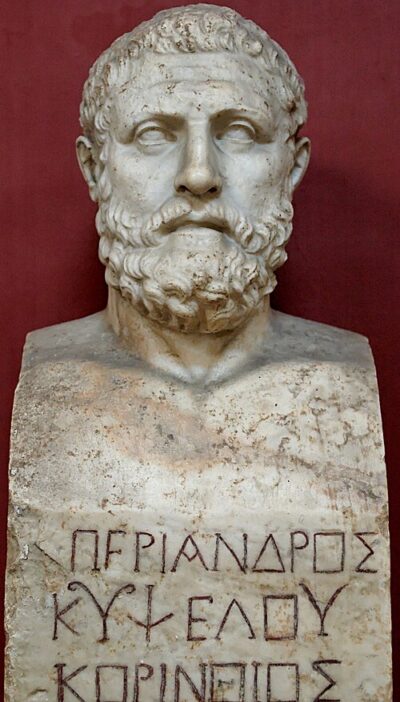
Periander
Periander was a second tyrant of Corinth. Born 7th century BC, in Corinth. Died 585 BC, in Corinth. Positions held include tyrant.
Facts
14 facts · 0 confirmed by two sources · 3 cited · 11 from one source
Where this comes from
Papalocal keeps its own record. It started from these sources; what each one said is kept here as it was copied, so a change on their side never changes this page by itself. Tap one to read its version.
What Wikidata says · copied November 16, 2026 · revision 2567995672
- Described as
- second tyrant of Corinth
- Other names
- Periandros
- Born
- 7th century BC
- Died
- 585 BC · 2 references
- Born in
- Corinth · 1 reference
- Died in
- Corinth
- Citizen of
- Ancient Corinth
- Occupation
- philosopher; writer; poet; tyrant · 1 reference; politician · 1 reference
- Positions held
- tyrant
- Spouse
- Melissa
- Children
- Lycophron of Corinth
- Father
- Cypselus
- Wikipedias with a page
- 53
Wikidata item Q328793 (wikidata.org/wiki/Q328793), public domain (CC0). Copied November 16, 2026.
What Wikipedia says · copied November 16, 2026 · revision 1365656518
Periander (; Greek: Περίανδρος; died c. 585 BC) was the second tyrant of the Cypselid dynasty that ruled over ancient Corinth. Periander's rule brought about a prosperous time in Corinth's history, as his administrative skill made Corinth one of the wealthiest city states in Greece. Several accounts state that Periander was a cruel and harsh ruler, but others claim that he was a fair and just king who worked to ensure that the distribution of wealth in Corinth was more or less even. He is often considered one of the Seven Sages of Greece, men of the 6th century BC who were renowned for centuries for their wisdom. (The other Sages were most often considered to be Thales, Solon, Cleobulus, Chilon, Bias and Pittacus.)
From the Wikipedia article “Periander” (en.wikipedia.org/wiki/Periander), by its contributors, under CC BY-SA 4.0 (creativecommons.org/licenses/by-sa/4.0/). Copied November 16, 2026; not changed.
Confirmed Two sources agree. Cited One source, and it names where it got it. One source One source, without a reference of its own. Sources disagree The sources disagree. We show the best-supported value and keep theirs below.
