
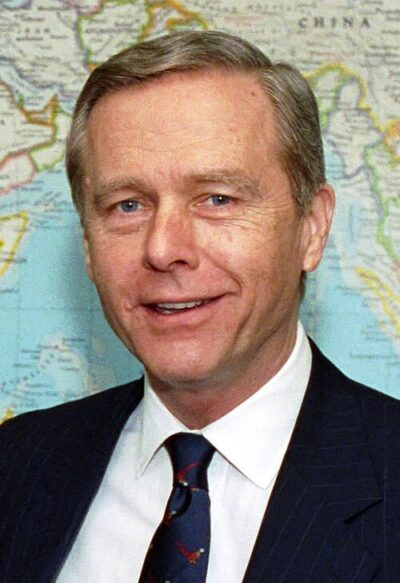
Pete Wilson
Pete Wilson is a Governor of California from 1991 to 1999. Born August 23, 1933, in Lake Forest. Positions held include member of the California State Assembly (1967–1971), Governor of California (1991–1999) and mayor of San Diego (1971–1983). Educated at Yale University and University of California, Berkeley School of Law.
Facts
20 facts · 1 confirmed by two sources · 8 cited · 11 from one source
Where this comes from
Papalocal keeps its own record. It started from these sources; what each one said is kept here as it was copied, so a change on their side never changes this page by itself. Tap one to read its version.
What Wikidata says · copied November 15, 2026 · revision 2568785201
- Described as
- Governor of California from 1991 to 1999
- Other names
- Peter Barton "Pete" Wilson, Peter Barton Wilson
- Born
- August 23, 1933 · 1 reference
- Born in
- Lake Forest · 1 reference
- Citizen of
- United States
- Occupation
- politician · 1 reference; military officer; lawyer · 1 reference; governor · 1 reference; jurist · 1 reference; mayor · 1 reference
- Positions held
- member of the California State Assembly (1967–1971); Governor of California (1991–1999); mayor of San Diego (1971–1983); United States senator (1983–1991) · 1 reference; senator · 1 reference
- Political party
- Republican Party
- Education
- Yale University; University of California, Berkeley School of Law; Mary Institute and St. Louis Country Day School · 1 reference
- Spouse
- Gayle Wilson
- Military branch
- United States Marine Corps
- Wikipedias with a page
- 26
Wikidata item Q714909 (wikidata.org/wiki/Q714909), public domain (CC0). Copied November 15, 2026.
What Wikipedia says · copied November 15, 2026 · revision 1384143893
Peter Barton Wilson (born August 23, 1933) is an American attorney and politician who served as the 36th governor of California from 1991 to 1999. A member of the Republican Party, Wilson previously served as a United States senator from California from 1983 to 1991, and as mayor of San Diego from 1971 to 1983.
Born in Lake Forest, Illinois, Wilson graduated from the UC Berkeley School of Law after serving in the United States Marine Corps. He established a legal practice in San Diego and campaigned for Republicans such as Richard Nixon and Barry Goldwater. Wilson won election to the California State Assembly in 1966 and became the mayor of San Diego in 1971. He held that office until 1983, when he became a member of the United States Senate. In 1982, he defeated then-incumbent Governor Jerry Brown to become the United States senator from California. In the Senate, Wilson supported the Strategic Defense Initiative and the Civil Liberties Act of 1988, while he opposed the Omnibus Budget Reconciliation Act of 1990.
Wilson resigned from the Senate after winning the 1990 California gubernatorial election. As governor, Wilson signed a three-strikes law and supported energy deregulation and term limits. He was also an advocate for California Proposition 187, which established a state-run citizenship screening system with the intention of preventing illegal immigrants from using social services; this was said to have contributed to the decline of the Republican Party's power in California. Wilson won reelection in the 1994 gubernatorial election. He sought the Republican nomination in the 1996 United States presidential election but dropped out of the race before the primaries began.
Wilson retired from public office after serving two terms as governor. Since leaving office, he has worked for several businesses and has been affiliated with several other organizations. He is a distinguished visiting fellow at the Hoover Institution. As of 2026, Wilson's 1988 re-election is the last time a Republican has won a U.S. Senate race in California.
- Born, in its opening lines
- August 23, 1933
From the Wikipedia article “Pete Wilson” (en.wikipedia.org/wiki/Pete_Wilson), by its contributors, under CC BY-SA 4.0 (creativecommons.org/licenses/by-sa/4.0/). Copied November 15, 2026; not changed.
Confirmed Two sources agree. Cited One source, and it names where it got it. One source One source, without a reference of its own. Sources disagree The sources disagree. We show the best-supported value and keep theirs below.
