
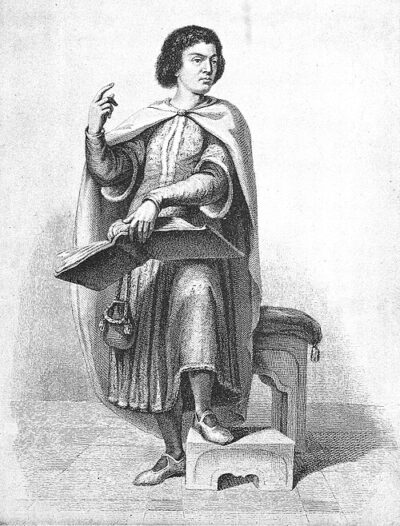
Peter Abelard
Peter Abelard was a French scholastic philosopher, theologian and preeminent logician (c.1079-1142). Born 1079, in Le Pallet. Died April 21, 1142, in Chalon-sur-Saône. Positions held include Abbot of Rhuys (1125–). Known for Sic et Non, Dialectica and Hymnarius Paraclithensis. Educated at Cathedral School of Paris.
Facts
32 facts · 2 confirmed by two sources · 11 cited · 19 from one source
Where this comes from
Papalocal keeps its own record. It started from these sources; what each one said is kept here as it was copied, so a change on their side never changes this page by itself. Tap one to read its version.
What Wikidata says · copied November 16, 2026 · revision 2567251857
- Described as
- French scholastic philosopher, theologian and preeminent logician (c.1079-1142)
- Other names
- Peter Abaelard, Peter Abailard, Abelardus, Petri Abaelardi, Abailard, Petrus Abailardus, Pierre Abeilard, Pierre Abailard, Piotr Abelard, Pierre Abelard, Peter Abélard, P. Abelard
- Born
- 1079 · 46 references
- Died
- April 21, 1142 · 4 references
- Born in
- Le Pallet · 3 references
- Died in
- Chalon-sur-Saône · 3 references
- Buried in
- Héloïse and Abélard's tomb (1817–) · 3 references
- Name at birth
- Pierre Abélard
- Citizen of
- Kingdom of France · 1 reference
- Occupation
- theologian · 2 references; philosopher · 2 references; composer; linguist; poet; autobiographer; logician; writer · 2 references
- Positions held
- Abbot of Rhuys (1125–) · 1 reference
- Education
- Cathedral School of Paris
- Known for
- Sic et Non; Dialectica · 1 reference; Hymnarius Paraclithensis; Historia Calamitatum; Collationes; Introductio ad theologiam · 1 reference; Theologia christiana; Planctus Israel super Samson; Expositio in Epistolam ad Romanos; Ethica
- Field
- philosophy; scholasticism
- Spouse
- Héloïse d’Argenteuil · 1 reference
- Children
- Astralabius
- Religion
- Catholicism · 1 reference
- Wikipedias with a page
- 103
Wikidata item Q4295 (wikidata.org/wiki/Q4295), public domain (CC0). Copied November 16, 2026.
What Wikipedia says · copied November 16, 2026 · revision 1377313470
Peter Abelard (12 February 1079 – 21 April 1142) was a French philosopher, logician, theologian, composer, and poet, regarded as one of the most brilliant and controversial theologians of his time. Born at Pallet, near Nantes, he became a popular lecturer in Paris, but his academic career was cut short after his love affair with his student and eventual wife, Héloïse d'Argenteuil. Their relationship and philosophical exchange later became the aspect of his life for which he is best known in history and popular culture.
In philosophy, Abelard challenged the prevailing philosophical orthodoxy and is celebrated for his logical treatment of the problem of universals through nominalism and conceptualism, thereby helping to prepare the way for nominalism, as well as for pioneering the role of intent in ethics. He has often been called the "Descartes of the twelfth century" and has been considered a forerunner of Rousseau, Kant, and Spinoza. He is also sometimes credited as a major forerunner of modern empiricism.
In Catholic theology, Abelard was condemned for his teaching on the Trinity. He is particularly known for developing the concept of limbo and for introducing the moral influence theory of atonement. His doctrine of the atonement emphasized the love of Christ as manifested in his life and Passion, which in turn calls forth a human response of love, and this conception has had a continuing influence. Abelard expressed its underlying purpose in the words: "The purpose and cause of the incarnation was that God might illuminate the world by his wisdom and stir it to the love of himself."
Abelard is also regarded, alongside Augustine, as one of the most significant forerunners of the modern self-reflective autobiographer. His publicly circulated autobiographical letter, The History of My Calamities, together with his public correspondence, helped establish the tone for later epistolary novels and public accounts of the private lives of prominent figures. His works also include Christian Theology, Ethics, and his letters to Héloïse.
- Born, in its opening lines
- February 12, 1079
- Died, in its opening lines
- April 21, 1142
From the Wikipedia article “Peter Abelard” (en.wikipedia.org/wiki/Peter_Abelard), by its contributors, under CC BY-SA 4.0 (creativecommons.org/licenses/by-sa/4.0/). Copied November 16, 2026; not changed.
Confirmed Two sources agree. Cited One source, and it names where it got it. One source One source, without a reference of its own. Sources disagree The sources disagree. We show the best-supported value and keep theirs below.
