
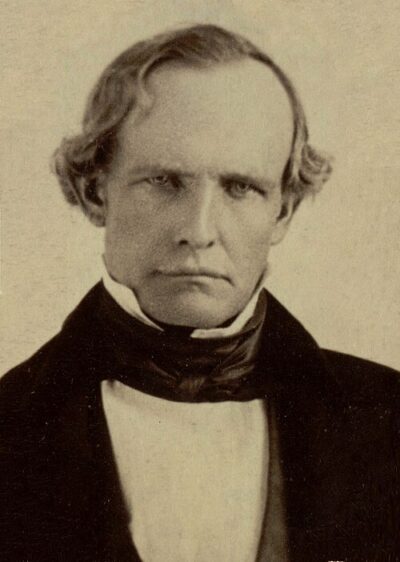
Peter Hardeman Burnett
Peter Hardeman Burnett was an American judge, governor of California, slave owner. Born November 15, 1807, in Nashville. Died May 17, 1895, in San Francisco. Positions held include Governor of California (1849–1851).
Facts
15 facts · 2 confirmed by two sources · 6 cited · 7 from one source
Where this comes from
Papalocal keeps its own record. It started from these sources; what each one said is kept here as it was copied, so a change on their side never changes this page by itself. Tap one to read its version.
What Wikidata says · copied November 16, 2026 · revision 2566907137
- Described as
- American judge, governor of California, slave owner (1807–1895)
- Born
- November 15, 1807 · 3 references
- Died
- May 17, 1895 · 2 references
- Born in
- Nashville · 1 reference
- Died in
- San Francisco · 1 reference
- Buried in
- Mission Santa Clara de Asís
- Cause of death
- diabetes
- Citizen of
- United States
- Occupation
- judge · 1 reference; lawyer · 1 reference; jurist · 1 reference; politician · 1 reference
- Positions held
- Governor of California (1849–1851)
- Political party
- Democratic Party
- Spouse
- Harriet Burnett
- Religion
- Catholicism
- Wikipedias with a page
- 23
Wikidata item Q280706 (wikidata.org/wiki/Q280706), public domain (CC0). Copied November 16, 2026.
What Wikipedia says · copied November 16, 2026 · revision 1384935328
Peter Hardeman Burnett (November 15, 1807 – May 17, 1895) was an American politician, the first elected governor of California from December 20, 1849, to January 9, 1851. Burnett was elected Governor almost one year before California's admission to the Union as the 31st state on September 9, 1850.
Raised in a slave-owning family in Missouri, Burnett moved westward after his business career left him heavily in debt. Initially residing in Oregon Country, he became Supreme Judge of the Provisional Government of Oregon. While in Oregon politics, he pushed for the total exclusion of African Americans from the territory. He authored the "Burnett's lash law" that authorized the flogging of any free blacks who refused to leave Oregon; the law was deemed "unduly harsh" and went unenforced before voters rescinded it in 1845.
In 1848, Burnett moved to California during the height of the California gold rush. He re-established his political career and was elected governor in 1849. Though Burnett himself had previously been a slave-owner in Tennessee, Burnett opposed calls to make California a slave state, instead pushing for the total exclusion of African Americans in California. Burnett signed into law the Act for the Government and Protection of Indians, which enabled the enslavement of Native Californians and contributed to their genocide. He declared in an 1851 speech, "[t]hat a war of extermination will continue to be waged between the races until the Indian race becomes extinct must be expected. While we cannot anticipate the result with but painful regret, the inevitable destiny of the race is beyond the power and wisdom of man to avert." Efforts by federal negotiators to preserve some Native land rights were fought by the administration of Burnett, who favored the elimination of California's indigenous peoples. Furthermore, Burnett is noted for being an early proponent of the exclusion of Chinese immigrant laborers from California, and following his governorship would advocate for the federal Chinese Exclusion Act.
He was appointed to serve on the Supreme Court of California in 1857. In this capacity, Burnett unsuccessfully ordered the extradition of Archy Lee, a formerly enslaved man living in Sacramento, back to Mississippi.
- Born, in its opening lines
- November 15, 1807
- Died, in its opening lines
- May 17, 1895
From the Wikipedia article “Peter Hardeman Burnett” (en.wikipedia.org/wiki/Peter_Hardeman_Burnett), by its contributors, under CC BY-SA 4.0 (creativecommons.org/licenses/by-sa/4.0/). Copied November 16, 2026; not changed.
Confirmed Two sources agree. Cited One source, and it names where it got it. One source One source, without a reference of its own. Sources disagree The sources disagree. We show the best-supported value and keep theirs below.
