
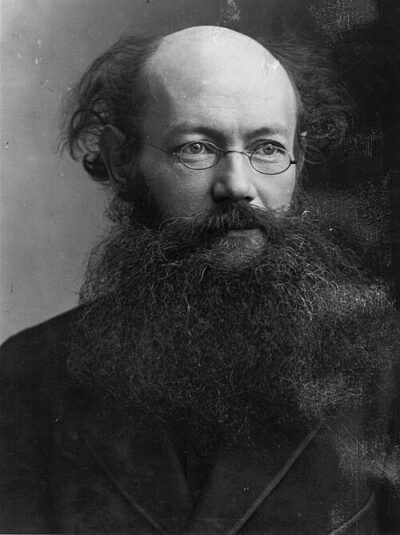
Peter Kropotkin
Peter Kropotkin was a Russian revolutionary socialist and philosopher. Born November 27, 1842, in Moscow. Died February 8, 1921, in Dmitrov. Known for Mutual Aid: A Factor of Evolution, The Conquest of Bread and Fields, Factories, and Workshops. Educated at Faculty of Physics and Mathematics of the Saint Petersburg University and Page Corps.
Facts
38 facts · 1 confirmed by two sources · 8 cited · 28 from one source · 1 where the sources disagree
What’s different
- Born: we show November 27, 1842 (Sources disagree). Wikipedia says December 9, 1842
Where this comes from
Papalocal keeps its own record. It started from these sources; what each one said is kept here as it was copied, so a change on their side never changes this page by itself. Tap one to read its version.
What Wikidata says · copied November 16, 2026 · revision 2565532463
- Described as
- Russian revolutionary socialist and philosopher (1842–1921)
- Other names
- Pyotr Alexeyevich Kropotkin, Pyotr Kropotkin, P. A. Kropotkin, P. Kropotkin, Prince Peter Krapotkin, Peter Alexeivitch Kropotkin
- Born
- November 27, 1842 · 4 references
- Died
- February 8, 1921 · 13 references
- Born in
- Moscow · 5 references
- Died in
- Dmitrov · 3 references
- Buried in
- Novodevichy Cemetery
- Cause of death
- pneumonia
- Citizen of
- Russian Empire; Russian Soviet Federative Socialist Republic; Russian Socialist Federative Soviet Republic · 1 reference
- Occupation
- geographer · 2 references; writer · 3 references; explorer; philosopher · 2 references; autobiographer; journalist; economist; anarchist
- Education
- Faculty of Physics and Mathematics of the Saint Petersburg University; Page Corps; First Moscow gymnasium · 1 reference
- Member of
- International Workingmen's Association
- Known for
- Mutual Aid: A Factor of Evolution; The Conquest of Bread; Fields, Factories, and Workshops; The Great French Revolution: 1789–1793; Memoirs of a Revolutionist; Russian Literature, Ideals and Realities; Ethics: Origin and Development
- Field
- philosophy; mutual aid · 1 reference; work · 1 reference; power · 1 reference; federalism · 1 reference; geography · 1 reference
- Spouse
- Sophie Kropotkin · 1 reference
- Children
- Alexandra Kropotkin · 1 reference
- Father
- Aleksey Kropotkin
- Mother
- Ekaterina Nikolaevna Kropotkina (nee Sulima)
- Wikipedias with a page
- 120
Wikidata item Q5752 (wikidata.org/wiki/Q5752), public domain (CC0). Copied November 16, 2026.
What Wikipedia says · copied November 16, 2026 · revision 1384907752
Pyotr Alexeyevich Kropotkin (9 December [O.S. 27 November] 1842 – 8 February 1921) was a Russian anarchist political philosopher and geographer known as a proponent of anarchist communism.
Born into an aristocratic land-owning family, Kropotkin attended the Page Corps and later served as an officer in Siberia, where he participated in several geological expeditions. He was imprisoned for his activism in 1874 and managed to escape two years later. He spent the next 41 years in exile in Switzerland, France (where he was imprisoned for almost four years), and England. While in exile, he gave lectures and published widely on anarchism and geography. Kropotkin returned to Russia after the Russian Revolution in 1917, but he was disappointed by the Bolshevik state.
Kropotkin was a proponent of the idea of decentralized communist society free from central government and based on voluntary associations of self-governing communities and worker-run enterprises. He wrote many books, pamphlets and articles, the most prominent being The Conquest of Bread (1892) and Fields, Factories, and Workshops (1899), with Mutual Aid: A Factor of Evolution (1902) being his principal scientific offering. He contributed the article on anarchism to the eleventh edition of the Encyclopædia Britannica and left an unfinished work on anarchist ethical philosophy.
- Born, in its opening lines
- December 9, 1842
- Died, in its opening lines
- February 8, 1921
From the Wikipedia article “Peter Kropotkin” (en.wikipedia.org/wiki/Peter_Kropotkin), by its contributors, under CC BY-SA 4.0 (creativecommons.org/licenses/by-sa/4.0/). Copied November 16, 2026; not changed.
Confirmed Two sources agree. Cited One source, and it names where it got it. One source One source, without a reference of its own. Sources disagree The sources disagree. We show the best-supported value and keep theirs below.
