
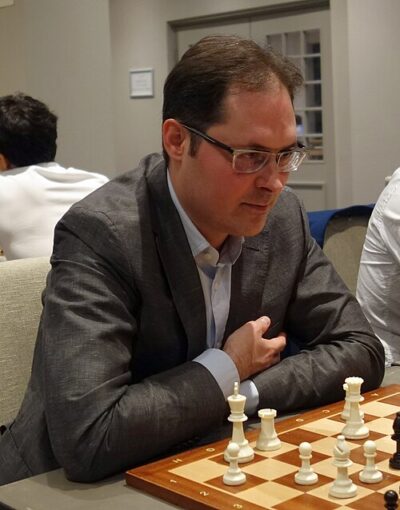
Peter Leko is a Hungarian chess player. Born September 8, 1979, in Subotica.
Facts
5 facts · 1 confirmed by two sources · 0 cited · 4 from one source
Where this comes from
Papalocal keeps its own record. It started from these sources; what each one said is kept here as it was copied, so a change on their side never changes this page by itself. Tap one to read its version.
What Wikidata says · copied November 16, 2026 · revision 2561577674
- Described as
- Hungarian chess player
- Born
- September 8, 1979 · 1 reference
- Born in
- Subotica
- Citizen of
- Hungary
- Occupation
- chess player
- Sport
- chess
- Wikipedias with a page
- 48
Wikidata item Q210922 (wikidata.org/wiki/Q210922), public domain (CC0). Copied November 16, 2026.
What Wikipedia says · copied November 16, 2026 · revision 1383860463
Peter Leko (Hungarian: Lékó Péter; born September 8, 1979) is a Hungarian chess grandmaster and commentator. He became the world's youngest grandmaster in 1994. He narrowly missed winning the Classical World Chess Championship 2004: the match was drawn 7–7 and so Vladimir Kramnik retained the title. He also came fifth in the FIDE World Chess Championship 2005 and fourth in the World Chess Championship 2007.
Leko has achieved victories in many major chess tournaments, including the annual tournaments at Dortmund, Linares, Wijk aan Zee and the Tal Memorial in Moscow. He won two team silver medals and an individual gold medal representing Hungary at eight Chess Olympiads as well as team bronze and silver and an individual silver medal at three European Team Championships.
Leko has been ranked as high as fourth in the FIDE world rankings, which he first achieved in April 2003.
- Born, in its opening lines
- September 8, 1979
From the Wikipedia article “Peter Leko” (en.wikipedia.org/wiki/Peter_Leko), by its contributors, under CC BY-SA 4.0 (creativecommons.org/licenses/by-sa/4.0/). Copied November 16, 2026; not changed.
Confirmed Two sources agree. Cited One source, and it names where it got it. One source One source, without a reference of its own. Sources disagree The sources disagree. We show the best-supported value and keep theirs below.
