
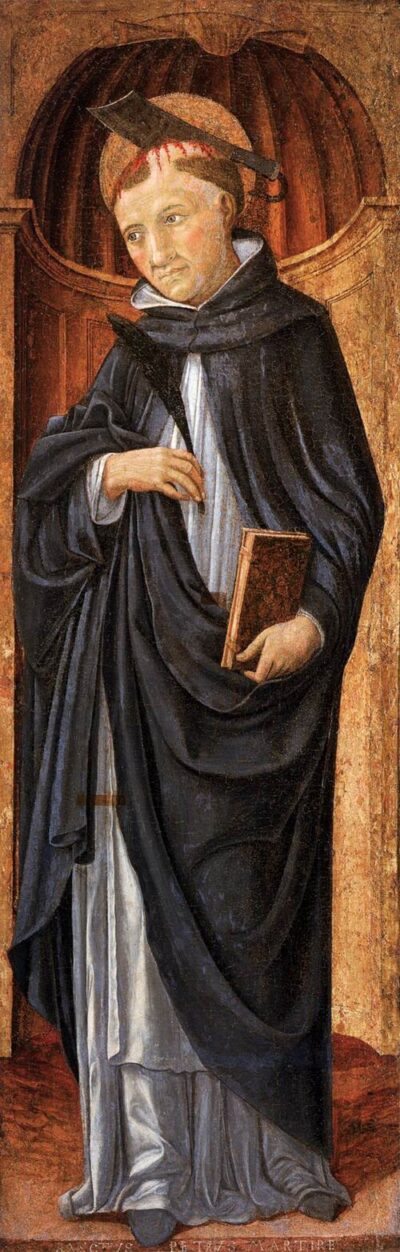
Peter of Verona
Peter of Verona was an Italian Roman Catholic priest, martyr, and saint. Born 1206, in Verona. Died April 6, 1252, in Seveso. Educated at University of Bologna.
Facts
9 facts · 1 confirmed by two sources · 0 cited · 7 from one source · 1 where the sources disagree
What’s different
- Born: we show 1206 (Sources disagree). Wikipedia says October 29, 1205
Where this comes from
Papalocal keeps its own record. It started from these sources; what each one said is kept here as it was copied, so a change on their side never changes this page by itself. Tap one to read its version.
What Wikidata says · copied November 18, 2026 · revision 2570807905
- Described as
- Italian Roman Catholic priest, martyr, and saint
- Other names
- St Peter the Martyr, Saint Peter Martyr, Saint Pierre Martyr, Peter Martyr, San Pietro da Verona, San Pietro Martire
- Born
- 1206
- Died
- April 6, 1252
- Born in
- Verona
- Died in
- Seveso
- Buried in
- Portinari Chapel
- Occupation
- presbyter; inquisitor
- Education
- University of Bologna
- Religion
- Catholic Church
- Wikipedias with a page
- 23
Wikidata item Q238744 (wikidata.org/wiki/Q238744), public domain (CC0). Copied November 18, 2026.
What Wikipedia says · copied November 18, 2026 · revision 1359684043
Peter of Verona (29 October 1205 – 6 April 1252), also known as Saint Peter Martyr and Saint Peter of Verona, was a 13th-century Italian Catholic priest. He was a Dominican friar and a celebrated preacher. He served as Inquisitor in Lombardy, was killed by an assassin, and was canonised as a Catholic saint 11 months after his death — the fastest canonisation in history.
- Born, in its opening lines
- October 29, 1205
- Died, in its opening lines
- April 6, 1252
From the Wikipedia article “Peter of Verona” (en.wikipedia.org/wiki/Peter_of_Verona), by its contributors, under CC BY-SA 4.0 (creativecommons.org/licenses/by-sa/4.0/). Copied November 18, 2026; not changed.
Confirmed Two sources agree. Cited One source, and it names where it got it. One source One source, without a reference of its own. Sources disagree The sources disagree. We show the best-supported value and keep theirs below.
