
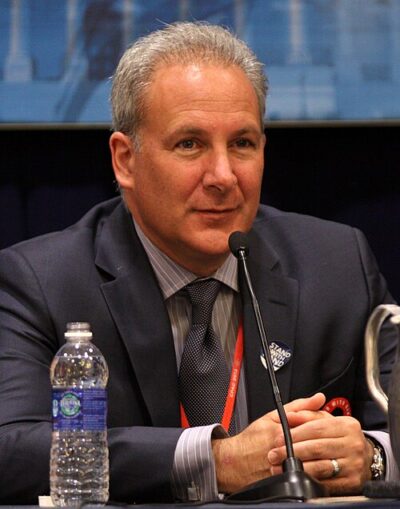
Peter Schiff
Peter Schiff is an American entrepreneur, economist and author. Born March 23, 1963, in New Haven. Educated at University of California, Berkeley and Haas School of Business.
Facts
18 facts · 1 confirmed by two sources · 3 cited · 14 from one source
Where this comes from
Papalocal keeps its own record. It started from these sources; what each one said is kept here as it was copied, so a change on their side never changes this page by itself. Tap one to read its version.
What Wikidata says · copied November 15, 2026 · revision 2564472143
- Described as
- American entrepreneur, economist and author
- Other names
- Peter David Schiff
- Born
- March 23, 1963 · 1 reference
- Born in
- New Haven
- Citizen of
- United States · 1 reference
- Occupation
- stockbroker; economist; businessperson; writer; pundit; investor · 1 reference; strategist · 3 references; blogger
- Political party
- Republican Party
- Worked for
- Euro Pacific Capital
- Education
- University of California, Berkeley; Haas School of Business · 1 reference; Beverly Hills High School · 1 reference
- Spouse
- Lauren McCord
- Father
- Irwin Schiff
- Wikipedias with a page
- 24
Wikidata item Q512741 (wikidata.org/wiki/Q512741), public domain (CC0). Copied November 15, 2026.
What Wikipedia says · copied November 15, 2026 · revision 1381539339
Peter David Schiff (; born March 23, 1963; nicknamed "Dr. Doom") is an American stockbroker, financial commentator, and radio personality. He co-founded Echelon Wealth Partners in Canada (formerly Euro Pacific Canada). He is involved in other financial services companies including Euro Pacific Asset Management, as an independent investment advisor, and Schiff Gold (formerly Euro Pacific Precious Metals). He has criticized US banking and credit practices.
- Born, in its opening lines
- March 23, 1963
From the Wikipedia article “Peter Schiff” (en.wikipedia.org/wiki/Peter_Schiff), by its contributors, under CC BY-SA 4.0 (creativecommons.org/licenses/by-sa/4.0/). Copied November 15, 2026; not changed.
Confirmed Two sources agree. Cited One source, and it names where it got it. One source One source, without a reference of its own. Sources disagree The sources disagree. We show the best-supported value and keep theirs below.
