
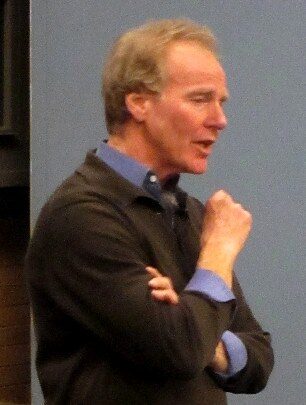
Peter Senge
Peter Senge is an American systems scientist. Born 1947, in Stanford. Known for The Fifth Discipline. Educated at MIT Sloan School of Management and Massachusetts Institute of Technology.
Facts
17 facts · 0 confirmed by two sources · 5 cited · 12 from one source
Where this comes from
Papalocal keeps its own record. It started from these sources; what each one said is kept here as it was copied, so a change on their side never changes this page by itself. Tap one to read its version.
What Wikidata says · copied November 15, 2026 · revision 2568496613
- Described as
- American systems scientist
- Other names
- Peter M. Senge
- Born
- 1947 · 5 references
- Born in
- Stanford · 1 reference
- Citizen of
- United States
- Occupation
- economist · 1 reference; pedagogue; writer; university teacher; philosopher · 1 reference; engineer · 1 reference; business consultant · 1 reference; docent · 1 reference
- Worked for
- Massachusetts Institute of Technology; MIT Sloan School of Management
- Education
- MIT Sloan School of Management; Massachusetts Institute of Technology · 1 reference; John H. Francis Polytechnic High School · 1 reference
- Known for
- The Fifth Discipline
- Wikipedias with a page
- 30
Wikidata item Q435801 (wikidata.org/wiki/Q435801), public domain (CC0). Copied November 15, 2026.
What Wikipedia says · copied November 15, 2026 · revision 1371984228
Peter Michael Senge (born 1947) is an American systems scientist who is a senior lecturer at the MIT Sloan School of Management, co-faculty at the New England Complex Systems Institute, and the founder of the Society for Organizational Learning. He is known as the author of the book The Fifth Discipline: The Art and Practice of the Learning Organization (1990, rev. 2006).
From the Wikipedia article “Peter Senge” (en.wikipedia.org/wiki/Peter_Senge), by its contributors, under CC BY-SA 4.0 (creativecommons.org/licenses/by-sa/4.0/). Copied November 15, 2026; not changed.
Confirmed Two sources agree. Cited One source, and it names where it got it. One source One source, without a reference of its own. Sources disagree The sources disagree. We show the best-supported value and keep theirs below.
