
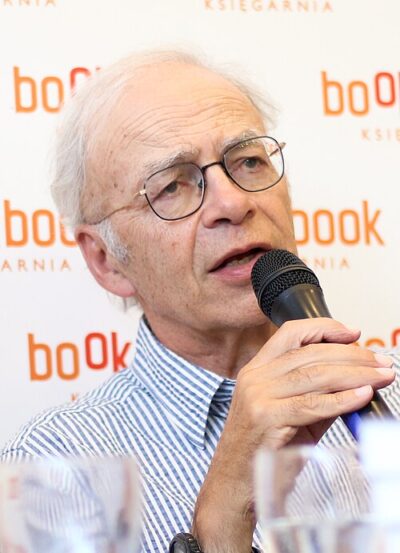
Peter Singer
Peter Singer is an Australian moral philosopher. Born July 6, 1946, in Melbourne. Positions held include advisory board. Known for Animal Liberation and The Life You Can Save. Educated at University College, Oxford and University of Melbourne. Awards include Ethics Prize of the Giordano Bruno Stiftung, Emperor Has No Clothes Award and Companion of the Order of Australia.
Facts
35 facts · 1 confirmed by two sources · 5 cited · 29 from one source
Where this comes from
Papalocal keeps its own record. It started from these sources; what each one said is kept here as it was copied, so a change on their side never changes this page by itself. Tap one to read its version.
What Wikidata says · copied November 16, 2026 · revision 2568772434
- Described as
- Australian moral philosopher (born 1946)
- Other names
- Peter Albert David Singer, Peter A. D. Singer, P. A. D. Singer, P. Singer, Singer, Peter Albert David, Singer
- Born
- July 6, 1946 · 8 references
- Born in
- Melbourne · 3 references
- Name at birth
- Peter Albert David Singer
- Citizen of
- Australia
- Occupation
- philosopher · 1 reference; professor; writer · 1 reference; politician · 1 reference
- Positions held
- advisory board
- Worked for
- Princeton University; New York University; University of Melbourne · 1 reference; Monash University; University College, Oxford; La Trobe University
- Education
- University College, Oxford (–1971); University of Melbourne (–1967); Scotch College; Preshil, The Margaret Lyttle Memorial School
- Member of
- Royal Society of Canada; American Academy of Arts and Sciences
- Known for
- Animal Liberation; The Life You Can Save · 1 reference
- Awards
- Ethics Prize of the Giordano Bruno Stiftung; Emperor Has No Clothes Award (2004); Companion of the Order of Australia (2012) · 1 reference; BBVA Foundation Frontiers of Knowledge Award (2022) · 1 reference; Fellow of the Australian Academy of the Humanities (1981) · 1 reference; Banjo Award for Non-Fiction (1995) · 1 reference
- Field
- bioethics · 1 reference; applied ethics
- Father
- Ernst Singer
- Mother
- Cora Singer
- Religion
- atheism
- Website
- https://petersinger.info/
- Wikipedias with a page
- 70
Wikidata item Q211539 (wikidata.org/wiki/Q211539), public domain (CC0). Copied November 16, 2026.
What Wikipedia says · copied November 16, 2026 · revision 1382993935
Peter Albert David Singer (born 6 July 1946) is an Australian moral philosopher who is Emeritus Ira W. DeCamp Professor of Bioethics at Princeton University. Singer's work specialises in applied ethics, approaching the subject from a secular, utilitarian perspective. His book Animal Liberation (1975) criticized intensive animal farming and speciesism, and shaped the animal rights movement. His essay "Famine, Affluence, and Morality" argues for the moral imperative of donating to help the global poor, using the drowning child analogy. For most of his career he was a preference utilitarian. He revealed in The Point of View of the Universe (2014), co-authored with Katarzyna de Lazari-Radek, that he had become a hedonistic utilitarian. His books The Life You Can Save (2009) and The Most Good You Can Do (2015) are influential in the effective altruism movement.
On two occasions, Singer served as chair of the philosophy department at Monash University, where he founded its Centre for Human Bioethics. In 1996, he stood unsuccessfully as a Greens candidate for the Australian Senate. In 2004, Singer was recognised as the Australian Humanist of the Year by the Council of Australian Humanist Societies. In 2005 The Sydney Morning Herald placed him among Australia's ten most influential public intellectuals. Singer is a co-founder of Animals Australia and the founder of the non-profit organisation The Life You Can Save.
- Born, in its opening lines
- July 6, 1946
From the Wikipedia article “Peter Singer” (en.wikipedia.org/wiki/Peter_Singer), by its contributors, under CC BY-SA 4.0 (creativecommons.org/licenses/by-sa/4.0/). Copied November 16, 2026; not changed.
Confirmed Two sources agree. Cited One source, and it names where it got it. One source One source, without a reference of its own. Sources disagree The sources disagree. We show the best-supported value and keep theirs below.
