
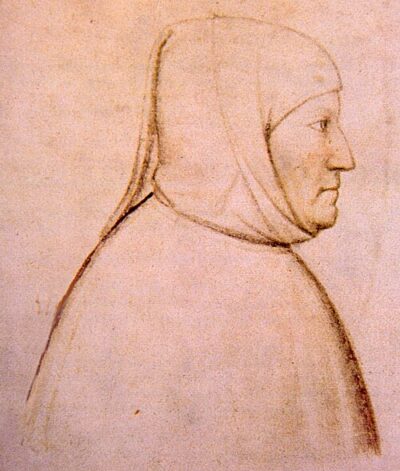
Petrarch
Petrarch was an Italian scholar and poet. Born July 20, 1304, in Arezzo. Died July 19, 1374, in Arquà Petrarca. Known for Il Canzoniere, Secretum and De viris illustribus. Educated at University of Montpellier (1289-1969) and University of Bologna. Awards include Poet's Crown.
Facts
35 facts · 2 confirmed by two sources · 7 cited · 26 from one source
Where this comes from
Papalocal keeps its own record. It started from these sources; what each one said is kept here as it was copied, so a change on their side never changes this page by itself. Tap one to read its version.
What Wikidata says · copied November 16, 2026 · revision 2569138731
- Described as
- Italian scholar and poet (1304-1374)
- Other names
- Francesco Petrarch, Francesco Peetrarque, Francis Petrarch, Petrarque, Peetrarque, Petrarca
- Born
- July 20, 1304 · 3 references
- Died
- July 19, 1374 · 2 references
- Born in
- Arezzo · 5 references
- Died in
- Arquà Petrarca · 2 references
- Buried in
- Arquà Petrarca · 1 reference
- Citizen of
- Republic of Florence
- Occupation
- philosopher · 2 references; poet · 5 references; translator; lyricist; writer · 6 references; mountaineer · 1 reference; autobiographer · 1 reference; philologist
- Education
- University of Montpellier (1289-1969) (1316–1320); University of Bologna (1320–1323)
- Sport
- mountaineering
- Genre
- poetry; prose
- Known for
- Il Canzoniere; Secretum; De viris illustribus; Rerum memorandarum libri; De otio religioso; De vita solitaria; De remediis utriusque fortunae; Invectivarum contra medicum quendam libri IV; Itinerarium ad sepulchrum domini nostri Yhesu Christi; Liber sine nomine
- Awards
- Poet's Crown (1341) · 1 reference
- Field
- philosophy
- Children
- Francesca
- Father
- Petracco
- Mother
- Eietta Canigiani · 1 reference
- Religion
- Catholic Church
- Wikipedias with a page
- 165
Wikidata item Q1401 (wikidata.org/wiki/Q1401), public domain (CC0). Copied November 16, 2026.
What Wikipedia says · copied November 16, 2026 · revision 1385563221
Francis Petrarch (born Francesco di Petracco; 20 July 1304 – 19 July 1374) was an Italian scholar and poet of the early Italian Renaissance, as well as one of the earliest Renaissance humanists.
Petrarch's rediscovery of Cicero's letters is often credited with initiating the 14th-century Italian Renaissance and the founding of Renaissance humanism. In the 16th century, Pietro Bembo created the model for the modern Italian language based on Petrarch's works, as well as those of Giovanni Boccaccio, and, to a lesser extent, Dante Alighieri. Petrarch was later endorsed as a model for Italian style by the Accademia della Crusca.
Petrarch's sonnets were admired and imitated throughout Europe during the Renaissance and became a model for lyrical poetry. He is also known for being the first to develop the concept of the "Dark Ages".
- Born, in its opening lines
- July 20, 1304
- Died, in its opening lines
- July 19, 1374
From the Wikipedia article “Petrarch” (en.wikipedia.org/wiki/Petrarch), by its contributors, under CC BY-SA 4.0 (creativecommons.org/licenses/by-sa/4.0/). Copied November 16, 2026; not changed.
Confirmed Two sources agree. Cited One source, and it names where it got it. One source One source, without a reference of its own. Sources disagree The sources disagree. We show the best-supported value and keep theirs below.
