
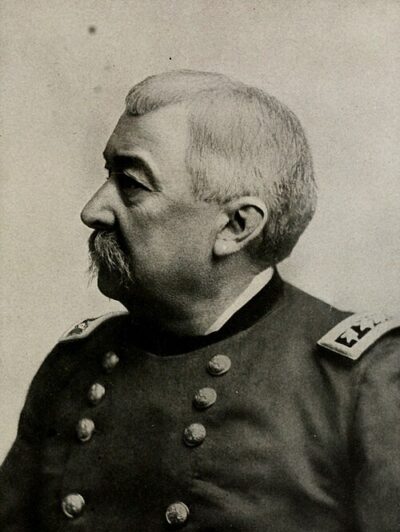
Philip Sheridan
Philip Sheridan was an United States Army general. Born March 6, 1831, in Albany. Died August 5, 1888, in Nonquitt. Educated at United States Military Academy.
Facts
18 facts · 2 confirmed by two sources · 5 cited · 11 from one source
Where this comes from
Papalocal keeps its own record. It started from these sources; what each one said is kept here as it was copied, so a change on their side never changes this page by itself. Tap one to read its version.
What Wikidata says · copied November 13, 2026 · revision 2558215857
- Described as
- United States Army general (1831-1888)
- Other names
- Philip Henry Sheridan, Philip H. Sheridan
- Born
- March 6, 1831 · 7 references
- Died
- August 5, 1888 · 7 references
- Born in
- Albany · 1 reference
- Died in
- Nonquitt · 1 reference
- Buried in
- Arlington National Cemetery · 1 reference
- Citizen of
- United States
- Occupation
- politician; writer · 1 reference; army officer; lieutenant general · 1 reference
- Political party
- Republican Party
- Education
- United States Military Academy
- Spouse
- Irene Rucker
- Children
- Philip Henry Sheridan
- Military branch
- Union Army; United States Army; cavalry
- Military rank
- General of the Army
- Wikipedias with a page
- 45
Wikidata item Q355452 (wikidata.org/wiki/Q355452), public domain (CC0). Copied November 13, 2026.
What Wikipedia says · copied November 13, 2026 · revision 1379665777
Philip Henry Sheridan (March 6, 1831 – August 5, 1888) was a career United States Army officer and a Union general in the American Civil War. His career was noted for his rapid rise to major general and his close association with General-in-chief Ulysses S. Grant, who transferred Sheridan from command of an infantry division in the Western Theater to lead the Cavalry Corps of the Army of the Potomac in the East. In 1864, he defeated Confederate forces under General Jubal Early in the Shenandoah Valley and his destruction of the economic infrastructure of the Valley, called "The Burning" by residents, was one of the first uses of scorched-earth tactics in the war. In 1865, his cavalry pursued Gen. Robert E. Lee and was instrumental in forcing his surrender at Appomattox Courthouse.
In his later years, Sheridan fought in the Indian Wars against Native American tribes of the Great Plains. He was instrumental in the development and protection of Yellowstone National Park, both as a soldier and a private citizen. In 1883, Sheridan was appointed general-in-chief of the U.S. Army, and in 1888 he was promoted to the rank of General of the Army during the term of President Grover Cleveland.
- Born, in its opening lines
- March 6, 1831
- Died, in its opening lines
- August 5, 1888
From the Wikipedia article “Philip Sheridan” (en.wikipedia.org/wiki/Philip_Sheridan), by its contributors, under CC BY-SA 4.0 (creativecommons.org/licenses/by-sa/4.0/). Copied November 13, 2026; not changed.
Confirmed Two sources agree. Cited One source, and it names where it got it. One source One source, without a reference of its own. Sources disagree The sources disagree. We show the best-supported value and keep theirs below.
