
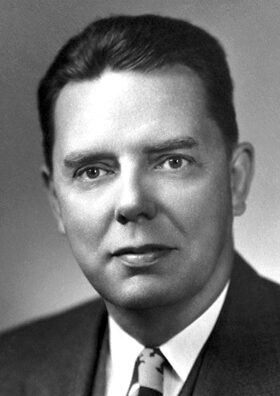
Philip Showalter Hench
Philip Showalter Hench was an American physician. Born February 28, 1896, in Pittsburgh. Died March 30, 1965, in Ocho Rios. Educated at Lafayette College and University of Pittsburgh. Awards include Nobel Prize in Physiology or Medicine and Lasker-DeBakey Clinical Medical Research Award.
Facts
22 facts · 2 confirmed by two sources · 5 cited · 15 from one source
Where this comes from
Papalocal keeps its own record. It started from these sources; what each one said is kept here as it was copied, so a change on their side never changes this page by itself. Tap one to read its version.
What Wikidata says · copied November 13, 2026 · revision 2563198836
- Described as
- American physician (1896-1965)
- Other names
- Philip Hench, Philip S. Hench, P. S. Hench, Ph. S. Hench, P S Hench, Ph S Hench, P. Hench, Ph. Hench, P Hench, Ph Hench, Hench, Hench-PS
- Born
- February 28, 1896 · 10 references
- Died
- March 30, 1965 · 9 references
- Born in
- Pittsburgh · 1 reference
- Died in
- Ocho Rios · 1 reference
- Buried in
- Oakwood Cemetery · 1 reference
- Cause of death
- pneumonia
- Citizen of
- United States
- Occupation
- physician · 1 reference; physiologist · 1 reference; endocrinologist; researcher
- Worked for
- Mayo Clinic (1923–)
- Education
- Lafayette College; University of Pittsburgh; University of Freiburg (1928–1929); Columbia University · 1 reference; Shady Side Academy
- Member of
- American Academy of Arts and Sciences; Académie Nationale de Médecine
- Awards
- Nobel Prize in Physiology or Medicine (1950) · 2 references; Lasker-DeBakey Clinical Medical Research Award (1949) · 1 reference
- Field
- medicine · 1 reference
- Wikipedias with a page
- 55
Wikidata item Q235651 (wikidata.org/wiki/Q235651), public domain (CC0). Copied November 13, 2026.
What Wikipedia says · copied November 13, 2026 · revision 1381402779
Philip Showalter Hench (February 28, 1896 – March 30, 1965) was an American physician. Hench, along with his Mayo Clinic co-worker Edward Calvin Kendall and Swiss chemist Tadeus Reichstein was awarded the Nobel Prize for Physiology or Medicine in 1950 for the discovery of the hormone cortisone, and its application for the treatment of rheumatoid arthritis. The Nobel Committee bestowed the award for the trio's "discoveries relating to the hormones of the adrenal cortex, their structure and biological effects."
Hench received his undergraduate education at Lafayette College in Easton, Pennsylvania, and received his medical training at the United States Army Medical Corps and the University of Pittsburgh. He began working at Mayo Clinic in 1923, later serving as the head of the Department of Rheumatology. In addition to the Nobel Prize, Hench received many other awards and honors throughout his career. He also had a lifelong interest in the history and discovery of yellow fever.
- Born, in its opening lines
- February 28, 1896
- Died, in its opening lines
- March 30, 1965
From the Wikipedia article “Philip Showalter Hench” (en.wikipedia.org/wiki/Philip_Showalter_Hench), by its contributors, under CC BY-SA 4.0 (creativecommons.org/licenses/by-sa/4.0/). Copied November 13, 2026; not changed.
Confirmed Two sources agree. Cited One source, and it names where it got it. One source One source, without a reference of its own. Sources disagree The sources disagree. We show the best-supported value and keep theirs below.
