
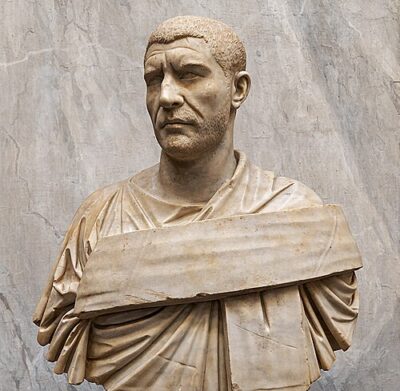
Philip the Arab
Philip the Arab was a Roman Emperor. Born 204, in Shahba. Died 249, in Verona. Positions held include Roman emperor (244–249), ancient Roman senator and Praetorian prefect.
Facts
14 facts · 2 confirmed by two sources · 2 cited · 10 from one source
What’s different
- Died: we show 249 (Confirmed). Wikidata also lists September 249 and October 249
Where this comes from
Papalocal keeps its own record. It started from these sources; what each one said is kept here as it was copied, so a change on their side never changes this page by itself. Tap one to read its version.
What Wikidata says · copied November 16, 2026 · revision 2568845216
- Described as
- Roman Emperor (204-249)
- Other names
- Philippus Arabs, Philip, Marcus Julius Philippus Arabs, Philip I
- Born
- 204 · 2 references
- Died
- 249 · 3 references; September 249; October 249
- Born in
- Shahba
- Died in
- Verona · 1 reference
- Citizen of
- Ancient Rome
- Occupation
- politician
- Positions held
- Roman emperor (244–249); ancient Roman senator; Praetorian prefect
- Spouse
- Marcia Otacilia Severa · 1 reference
- Children
- Philippus II
- Father
- Julius Marinus
- Siblings
- Gaius Julius Priscus
- Religion
- ancient Roman religion
- Wikipedias with a page
- 76
Wikidata item Q1817 (wikidata.org/wiki/Q1817), public domain (CC0). Copied November 16, 2026.
What Wikipedia says · copied November 16, 2026 · revision 1383976151
Philip I (Latin: Marcus Julius Philippus; c. 204 – September 249), commonly known as Philip the Arab, was the Roman emperor from 244 to 249. Although his reign lasted only five years, it marked an unusually stable period during the Crisis of the Third Century.
Born in modern-day Shahba, Syria, in what was then Arabia Petraea to a family likely of Arab descent, Philip was praetorian prefect during Emperor Gordian III's campaign against Shapur I's Sasanian Empire. When Gordian died under disputed circumstances following the Battle of Misiche, Philip was proclaimed emperor. He quickly negotiated peace with the Sasanians and returned to Rome to be confirmed by the Senate. In 246, Philip successfully repelled an incursion by the Carpi across the Danube. He then commemorated Rome's first millennium in 248 with a series of large-scale festivals and games.
A series of rebellions and renewed Barbarian incursions broke out from late 248, prompting Philip to dispatch Decius to Moesia and Pannonia. A victorious Decius was proclaimed emperor by his troops and immediately marched on Rome. Philip was defeated at Verona, where he was killed during or shortly after the battle, and Decius was subsequently recognised by the Senate as his successor.
While Philip publicly adhered to the Roman religion, he was later purported to have been a Christian, and in the later half of the 3rd century and into the early 4th century, some Catholic clergymen held the same belief. He was described as such in many published works that became widely known during the Middle Ages. Consequently, Philip's religious affiliation remains a divisive topic in modern scholarly debate about his life.
- Born, in its opening lines
- c. 204
- Died, in its opening lines
- September 249
From the Wikipedia article “Philip the Arab” (en.wikipedia.org/wiki/Philip_the_Arab), by its contributors, under CC BY-SA 4.0 (creativecommons.org/licenses/by-sa/4.0/). Copied November 16, 2026; not changed.
Confirmed Two sources agree. Cited One source, and it names where it got it. One source One source, without a reference of its own. Sources disagree The sources disagree. We show the best-supported value and keep theirs below.
