
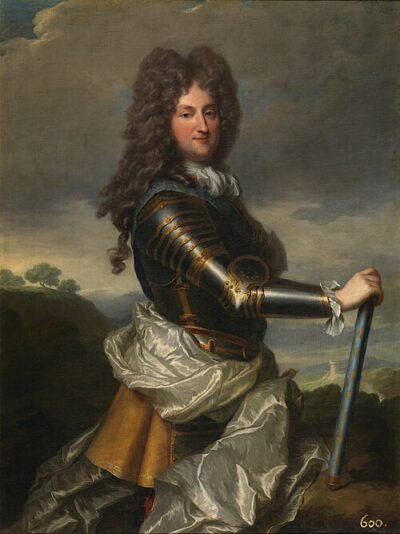
Philippe II, Duke of Orléans
Philippe II, Duke of Orléans was a member of the royal family of France, Regent of the Kingdom from 1715 to 1723. Born August 2, 1674, in Château de Saint-Cloud. Died December 2, 1723, in Versailles. Positions held include regent. Known for Orleans Collection. Awards include Knight of the Order of the Holy Spirit, Knight of the Order of Saint Michael and Knight of the Order of the Golden Fleece.
Facts
40 facts · 2 confirmed by two sources · 18 cited · 20 from one source
Where this comes from
Papalocal keeps its own record. It started from these sources; what each one said is kept here as it was copied, so a change on their side never changes this page by itself. Tap one to read its version.
What Wikidata says · copied November 16, 2026 · revision 2569996555
- Described as
- member of the royal family of France, Regent of the Kingdom from 1715 to 1723 (1674–1723)
- Other names
- Philippe d'Orléans, Regent of the Kingdom, Philippe II, Philippe d'Orleans, Philippe d' Orleans, Philippe von Orléans, Philippe D' Orleans, Philippe von Orleans, Philippe II, Duke of Orleans, Philippe, Duke of Orléans
- Born
- August 2, 1674 · 9 references
- Died
- December 2, 1723 · 8 references
- Born in
- Château de Saint-Cloud · 2 references
- Died in
- Versailles · 2 references
- Buried in
- Basilica of Saint-Denis
- Citizen of
- France · 1 reference
- Occupation
- art collector; military personnel · 2 references; ruler · 2 references; artist · 2 references; painter · 2 references; etcher · 2 references; composer · 1 reference
- Positions held
- regent
- Known for
- Orleans Collection
- Awards
- Knight of the Order of the Holy Spirit; Knight of the Order of Saint Michael; Knight of the Order of the Golden Fleece
- Spouse
- Françoise Marie de Bourbon (1692–) · 1 reference
- Children
- Louise Élisabeth d'Orléans · 1 reference; Louis d'Orléans, Duke of Orléans · 2 references; Charlotte Aglaé d'Orléans; Louise Adélaïde d'Orléans; Philippine Élisabeth d'Orléans; Louise Diane d'Orléans · 1 reference; Jean Philippe d'Orléans; Marie Louise Élisabeth d'Orléans · 1 reference; Charles de Saint-Albin · 1 reference; unknown daughter d'Orléans · 1 reference; unknown daughter d'Orléans · 1 reference; Angélique de Froissy · 1 reference
- Father
- Philippe I, Duke of Orléans · 1 reference
- Mother
- Elizabeth Charlotte of the Palatinate, Duchess of Orléans
- Siblings
- Philippe Charles, Duke of Valois; Marie Louise d'Orléans; Anne Marie d'Orléans; Élisabeth Charlotte of Orléans; Alexandre-Louis d'Orléans · 1 reference
- Religion
- Catholic Church
- Military rank
- general
- Wikipedias with a page
- 43
Wikidata item Q155596 (wikidata.org/wiki/Q155596), public domain (CC0). Copied November 16, 2026.
What Wikipedia says · copied November 16, 2026 · revision 1381408168
Philippe, Duke of Orléans (Philippe Charles; 2 August 1674 – 2 December 1723), known as the Regent, was a French prince, soldier, and statesman who served as Regent of the Kingdom of France from 1715 to 1723. He is referred to in French as le Régent. He was the son of Philippe I, Duke of Orleans, and Elisabeth Charlotte of the Palatinate. Born at his father's palace at Saint-Cloud, he was known from birth by the title of Duke of Chartres.
In 1692, Philippe married his first cousin Françoise Marie de Bourbon, the youngest legitimised daughter (légitimée de France) of King Louis XIV and Madame de Montespan. Named regent of France during the minority of Louis XV, his great-nephew and first cousin twice removed, the period of his de facto rule was known as the Regency (French: la Régence) (1715 - 1723). The Regency came to an end in February 1723, and the Duke of Orléans died at Versailles in December.
- Born, in its opening lines
- August 2, 1674
- Died, in its opening lines
- December 2, 1723
From the Wikipedia article “Philippe II, Duke of Orléans” (en.wikipedia.org/wiki/Philippe_II,_Duke_of_Orléans), by its contributors, under CC BY-SA 4.0 (creativecommons.org/licenses/by-sa/4.0/). Copied November 16, 2026; not changed.
Confirmed Two sources agree. Cited One source, and it names where it got it. One source One source, without a reference of its own. Sources disagree The sources disagree. We show the best-supported value and keep theirs below.
