
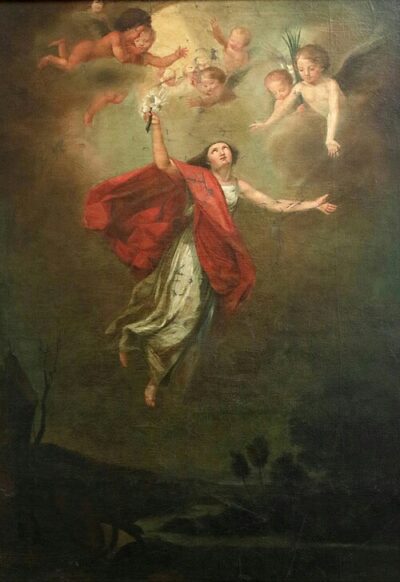
Philomena
Philomena was a Christian saint, martyr and wonderworker. Born January 10, 291, in Corfu. Died August 10, 304, in Rome.
Facts
7 facts · 2 confirmed by two sources · 1 cited · 4 from one source
Where this comes from
Papalocal keeps its own record. It started from these sources; what each one said is kept here as it was copied, so a change on their side never changes this page by itself. Tap one to read its version.
What Wikidata says · copied November 16, 2026 · revision 2567383672
- Described as
- Christian saint, martyr and wonderworker
- Other names
- Saint Philomena, Philomena of Rome, Philomena, Virgin and Martyr, Filomena de Roma
- Born
- January 10, 291
- Died
- August 10, 304
- Born in
- Corfu
- Died in
- Rome · 1 reference
- Cause of death
- decapitation
- Citizen of
- Ancient Rome
- Religion
- Catholic Church
- Wikipedias with a page
- 35
Wikidata item Q466428 (wikidata.org/wiki/Q466428), public domain (CC0). Copied November 16, 2026.
What Wikipedia says · copied November 16, 2026 · revision 1384851516
Philomena ( FIL-ə-MEE-nə), also known as Saint Philomena (Ancient Greek: Ἁγία Φιλουμένη, romanized: Hagía Philouménē; Modern Greek: Αγία Φιλομένα, romanized: Agía Filoména) or Philomena of Rome (c. 10 January 291 – c. 10 August 304) was a Greek virgin martyr whose remains were discovered on 24–25 May 1802, in the Catacomb of Priscilla. Three tiles enclosing the tomb bore an inscription, Pax Tecum Filumena (i.e. "Peace be unto you, Philomena"), that was taken to indicate that her name (in the Latin of the inscription) was Filumena (Ancient Greek: φιλουμένη, romanized: philouménē, lit. 'beloved'), the English form of which is Philomena. Philomena is the patron saint of babies, infants, and youth, and is known as "The Wonderworker". Although never formally canonized in the Catholic Church, Philomena is venerated by devotees in the Catholic and Coptic Orthodox Churches; while both Churches have churches and shrines dedicated to her.
The remains were moved to Mugnano del Cardinale in 1805. There, they became the focus of widespread devotion; several miracles were credited to Philomena's intercession, including the healing of Pauline Jaricot in 1835, which received wide publicity. John Vianney attributed to her intercession the extraordinary cures that others attributed to him.
From 1837 to 1961, celebration of her feast day was approved for regional calendars, but was never included in the General Roman Calendar. The 1920 typical edition of the Roman Missal included a mention of her, under 11 August, in the section headed Missae pro aliquibus locis ("Masses for some places"), with an indication that the Mass to be used in those places was one from the common of a virgin martyr, without any proper.
- Born, in its opening lines
- January 10, 291
- Died, in its opening lines
- August 10, 304
From the Wikipedia article “Philomena” (en.wikipedia.org/wiki/Philomena), by its contributors, under CC BY-SA 4.0 (creativecommons.org/licenses/by-sa/4.0/). Copied November 16, 2026; not changed.
Confirmed Two sources agree. Cited One source, and it names where it got it. One source One source, without a reference of its own. Sources disagree The sources disagree. We show the best-supported value and keep theirs below.
