
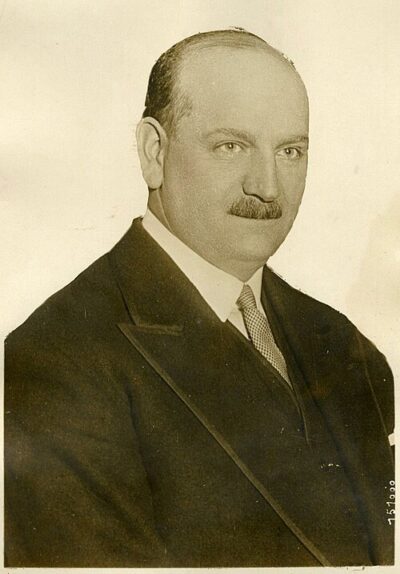
Pierre-Étienne Flandin
Pierre-Étienne Flandin was a French prime minister. Born April 12, 1889, in 16th arrondissement of Paris. Died June 13, 1958, in Saint-Jean-Cap-Ferrat. Positions held include member of the French National Assembly (1914–1940), President of the Council (1934–1935) and Deputy Prime Minister of France (1940–1941).
Facts
19 facts · 2 confirmed by two sources · 7 cited · 10 from one source
Where this comes from
Papalocal keeps its own record. It started from these sources; what each one said is kept here as it was copied, so a change on their side never changes this page by itself. Tap one to read its version.
What Wikidata says · copied November 16, 2026 · revision 2562699753
- Described as
- French prime minister (1889-1958)
- Other names
- Pierre-Etienne Flandin
- Born
- April 12, 1889 · 9 references
- Died
- June 13, 1958 · 9 references
- Born in
- 16th arrondissement of Paris
- Died in
- Saint-Jean-Cap-Ferrat · 1 reference
- Buried in
- Yonne
- Citizen of
- France
- Occupation
- politician; jurist · 1 reference; political scientist · 1 reference; foreign minister · 1 reference
- Positions held
- member of the French National Assembly (1914–1940); President of the Council (1934–1935); Deputy Prime Minister of France (1940–1941)
- Political party
- Democratic Republican Alliance (1914–1940)
- Field
- law · 1 reference; politics · 1 reference; political science · 1 reference
- Father
- Étienne Flandin
- Mother
- Pauline Ribière
- Wikipedias with a page
- 30
Wikidata item Q471296 (wikidata.org/wiki/Q471296), public domain (CC0). Copied November 16, 2026.
What Wikipedia says · copied November 16, 2026 · revision 1382617580
Pierre-Étienne Flandin (French: [pjɛʁ etjɛn flɑ̃dɛ̃]; 12 April 1889 – 13 June 1958) was a French conservative politician of the Third Republic, leader of the Democratic Republican Alliance (ARD), and Prime Minister of France from 1934 to 1935.
A military pilot during World War I, Flandin held a number of cabinet posts during the interwar period. He was minister of commerce, under the premiership of Frédéric François-Marsal, for just five days in 1924. He was minister of commerce and industry in the premierships of André Tardieu in 1931 and 1932. Between those posts, he served under Pierre Laval as finance minister. In 1934 (6 February to 8 November), he was minister of public works in the second cabinet of Gaston Doumergue. He became prime minister in November 1934, but his premiership lasted only until June 1935. However, a number of important pacts were negotiated during his term: the Franco-Italian Agreement of 1935, the Stresa Front and the Franco-Soviet Pact. Flandin was, at 45, the youngest prime minister in French history.
Flandin was the French foreign minister when Adolf Hitler ordered the Wehrmacht to reoccupy the Rhineland on 7 March 1936. He attempted to organize a strong response but was unable to without British support. Supporting appeasement during the Munich crisis hurt his career. On 13 December 1940, Vichy Chief of State Philippe Pétain appointed Flandin foreign minister and deputy prime minister, replacing Pierre Laval. He occupied that position for only two months.
He was ousted by François Darlan in January 1941.
After the Liberation of France, Flandin was put on trial for treason but the high court acquitted him. He was instead sentenced to 5 years in prison for "national unworthiness"; however, his sentence was remitted due to his help of the resistance during the war.
A street in Avallon was named in his honour. In May 2017, it was renamed in honour of the murdered British MP, Jo Cox.
- Born, in its opening lines
- April 12, 1889
- Died, in its opening lines
- June 13, 1958
From the Wikipedia article “Pierre-Étienne Flandin” (en.wikipedia.org/wiki/Pierre-Étienne_Flandin), by its contributors, under CC BY-SA 4.0 (creativecommons.org/licenses/by-sa/4.0/). Copied November 16, 2026; not changed.
Confirmed Two sources agree. Cited One source, and it names where it got it. One source One source, without a reference of its own. Sources disagree The sources disagree. We show the best-supported value and keep theirs below.
