
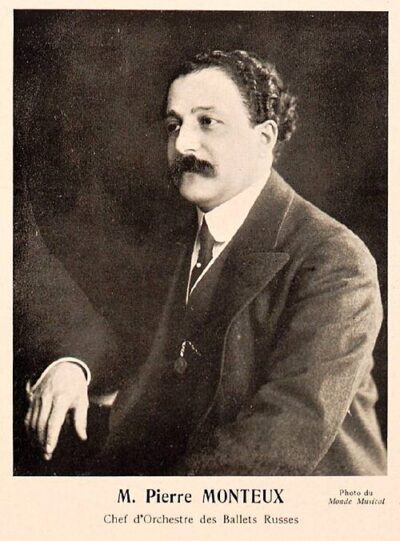
Pierre Monteux
Pierre Monteux was a French conductor. Born April 4, 1875, in Paris. Died July 1, 1964, in Hancock. Educated at Conservatoire de Paris. Awards include Royal Philharmonic Society Gold Medal, star on Hollywood Walk of Fame and Commander of the Legion of Honour.
Facts
23 facts · 2 confirmed by two sources · 9 cited · 12 from one source
Where this comes from
Papalocal keeps its own record. It started from these sources; what each one said is kept here as it was copied, so a change on their side never changes this page by itself. Tap one to read its version.
What Wikidata says · copied November 15, 2026 · revision 2558217091
- Described as
- French conductor (1875-1964)
- Other names
- Pierre Benjamin Monteux
- Born
- April 4, 1875 · 12 references
- Died
- July 1, 1964 · 13 references
- Born in
- Paris · 3 references
- Died in
- Hancock · 2 references
- Buried in
- Riverside Cemetery · 1 reference
- Name at birth
- Pierre Benjamin Monteux
- Citizen of
- France; United States (1942–)
- Occupation
- conductor · 2 references; recording artist; musician · 1 reference
- Political party
- Democratic Party
- Education
- Conservatoire de Paris · 1 reference
- Instrument
- violin; viola
- Awards
- Royal Philharmonic Society Gold Medal (1963); star on Hollywood Walk of Fame · 1 reference; Commander of the Legion of Honour; Knight of the Order of Orange-Nassau
- Spouse
- Doris Hodgkins Monteux · 1 reference
- Children
- Claude Monteux
- Siblings
- Henri Monteux · 1 reference; Paul Monteux · 1 reference
- Wikipedias with a page
- 26
Wikidata item Q434972 (wikidata.org/wiki/Q434972), public domain (CC0). Copied November 15, 2026.
What Wikipedia says · copied November 15, 2026 · revision 1383659048
Pierre Benjamin Monteux (pronounced [pjɛʁ mɔ̃.tø]; 4 April 1875 – 1 July 1964) was a French (later American) conductor. After violin and viola studies, and a decade as an orchestral player and occasional conductor, he began to receive regular conducting engagements in 1907. He came to prominence when, for Sergei Diaghilev's Ballets Russes company between 1911 and 1914, he conducted the world premieres of Stravinsky's The Rite of Spring and other prominent works including Petrushka, The Nightingale, Ravel's Daphnis et Chloé, and Debussy's Jeux. Thereafter he directed orchestras around the world for more than half a century.
From 1917 to 1919 Monteux was the principal conductor of the French repertoire at the Metropolitan Opera in New York. He conducted the Boston Symphony Orchestra (1919–24), Amsterdam Concertgebouw Orchestra (1924–34), Orchestre Symphonique de Paris (1929–38) and San Francisco Symphony (1936–52). In 1961, aged eighty-six, he accepted the chief conductorship of the London Symphony Orchestra, a post which he held until his death three years later. Although he was known for his performances of the French repertoire, his chief love was the music of German composers, above all Brahms. He disliked recording, finding it incompatible with spontaneity, but he nevertheless made a substantial number of records.
Monteux was well known as a teacher. In 1932 he began a conducting class in Paris, which he developed into a summer school that was later moved to his summer home in Les Baux in the south of France. After moving permanently to the US in 1942 and taking American citizenship, he founded a school for conductors and orchestral musicians in Hancock, Maine. Among his students in France and America who went on to international fame were Lorin Maazel, Igor Markevitch, Neville Marriner, Seiji Ozawa, André Previn and David Zinman. The school in Hancock has continued since Monteux's death.
- Born, in its opening lines
- April 4, 1875
- Died, in its opening lines
- July 1, 1964
From the Wikipedia article “Pierre Monteux” (en.wikipedia.org/wiki/Pierre_Monteux), by its contributors, under CC BY-SA 4.0 (creativecommons.org/licenses/by-sa/4.0/). Copied November 15, 2026; not changed.
Confirmed Two sources agree. Cited One source, and it names where it got it. One source One source, without a reference of its own. Sources disagree The sources disagree. We show the best-supported value and keep theirs below.
