
Piers Gaveston, 1st Earl of Cornwall
Piers Gaveston, 1st Earl of Cornwall was a Favourite of King Edward II of England. Born 1284, in Gascony. Died June 19, 1312, in Warwickshire. Positions held include Lord Lieutenant of Ireland.
Facts
10 facts · 2 confirmed by two sources · 2 cited · 6 from one source
Where this comes from
Papalocal keeps its own record. It started from these sources; what each one said is kept here as it was copied, so a change on their side never changes this page by itself. Tap one to read its version.
What Wikidata says · copied November 16, 2026 · revision 2552662783
- Described as
- Favourite of King Edward II of England (1284-1312)
- Born
- 1284 · 5 references
- Died
- June 19, 1312 · 1 reference
- Born in
- Gascony
- Died in
- Warwickshire
- Cause of death
- decapitation
- Citizen of
- France
- Occupation
- politician
- Positions held
- Lord Lieutenant of Ireland
- Spouse
- Margaret de Clare (1307–) · 2 references
- Children
- Amy de Gaveston · 1 reference
- Wikipedias with a page
- 28
Wikidata item Q710482 (wikidata.org/wiki/Q710482), public domain (CC0). Copied November 16, 2026.
What Wikipedia says · copied November 16, 2026 · revision 1380863907
Piers Gaveston, 1st Earl of Cornwall (c. 1284 – 19 June 1312) was an English nobleman of Gascon origin, and the favourite of Edward II of England.
At a young age, Gaveston made a good impression on King Edward I, who assigned him to the household of the King's son, Edward of Caernarfon. The prince's partiality for Gaveston was so extravagant that Edward I sent Gaveston into exile, but he was recalled a few months later, after the King's death led to the prince's accession as Edward II. Edward bestowed the Earldom of Cornwall on Gaveston, and arranged for him to marry Edward's niece Margaret de Clare, sister of the powerful Earl of Gloucester.
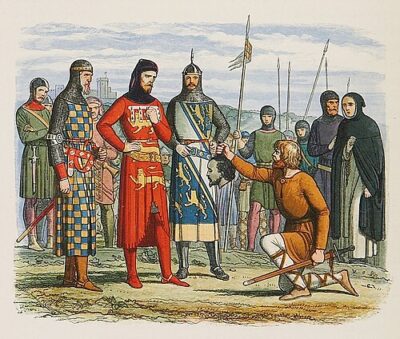
Gaveston's exclusive access to the King provoked several members of the nobility, and in 1308, the King agreed to send him into exile. During this absence, he served as the King's Lord Lieutenant of Ireland. Edward managed to negotiate a deal with the opposition, however, and Gaveston returned the next year. Upon his return his behaviour became even more offensive, and, by the Ordinances of 1311, it was decided that Gaveston should be exiled for a third time, to suffer outlawry if he returned. He did however return in late 1311 and, in 1312, he was hunted down and executed by a group of magnates led by Thomas, 2nd Earl of Lancaster, and Guy de Beauchamp, 10th Earl of Warwick.
It was alleged by medieval chroniclers (as discussed below under "Questions of sexuality") that Edward II and Piers Gaveston were lovers, which was reinforced by later portrayals in fiction, such as Christopher Marlowe's late 16th-century play Edward II. This assertion has received the support of some modern historians, while others have questioned it. According to Pierre Chaplais, the relationship between the two was that of an adoptive brotherhood, and Gaveston served as an unofficial deputy for a reluctant king. Other historians, like J.S. Hamilton, have pointed out that concern over the two men's sexuality was not the crux of the nobility's grievances, which rather centred on Gaveston's exclusive access to royal patronage.
- Born, in its opening lines
- c. 1284
- Died, in its opening lines
- June 19, 1312
From the Wikipedia article “Piers Gaveston, 1st Earl of Cornwall” (en.wikipedia.org/wiki/Piers_Gaveston,_1st_Earl_of_Cornwall), by its contributors, under CC BY-SA 4.0 (creativecommons.org/licenses/by-sa/4.0/). Copied November 16, 2026; not changed.
Confirmed Two sources agree. Cited One source, and it names where it got it. One source One source, without a reference of its own. Sources disagree The sources disagree. We show the best-supported value and keep theirs below.
