
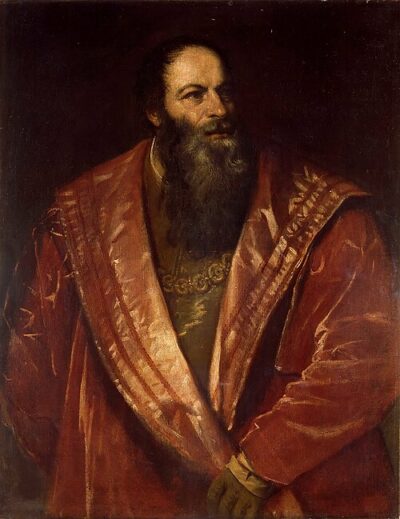
Pietro Aretino
Pietro Aretino was an Italian author, playwright, poet, satirist, and blackmailer. Born April 1492, in Arezzo. Died October 21, 1556, in Venice.
Facts
18 facts · 2 confirmed by two sources · 12 cited · 4 from one source
Where this comes from
Papalocal keeps its own record. It started from these sources; what each one said is kept here as it was copied, so a change on their side never changes this page by itself. Tap one to read its version.
What Wikidata says · copied November 16, 2026 · revision 2567748712
- Described as
- Italian author, playwright, poet, satirist, and blackmailer (1492-1556)
- Other names
- Piero Aretino, Pietro del Tura, Arétin, Aretin, Partenio Etiro
- Born
- April 1492 · 2 references
- Died
- October 21, 1556 · 5 references
- Born in
- Arezzo · 1 reference
- Died in
- Venice · 1 reference
- Buried in
- Venice
- Cause of death
- death from laughter
- Citizen of
- Republic of Venice
- Occupation
- poet · 3 references; playwright · 1 reference; journalist; writer · 3 references; art historian · 2 references; collector · 1 reference; art critic · 1 reference; satirist · 1 reference
- Field
- satirical literature · 1 reference; drama · 1 reference; lyricism · 1 reference
- Wikipedias with a page
- 58
Wikidata item Q296272 (wikidata.org/wiki/Q296272), public domain (CC0). Copied November 16, 2026.
What Wikipedia says · copied November 16, 2026 · revision 1385390828
Pietro Aretino (US: , Italian: [ˈpjɛːtro areˈtiːno]; 19 or 20 April 1492 – 21 October 1556) was an Italian author, playwright, poet, satirist and blackmailer, who wielded influence on contemporary art and politics. He was one of the most influential writers of his time and an outspoken critic of the powerful. He gained prominence through his politically charged writings and biting satire, which targeted powerful figures, including monarchs and popes. His works spanned various genres, including poetry, drama, and religious commentary, but he is particularly noted for his lampoons and erotic literature. Owing to his communications and sympathies with religious reformers, he is considered to have been a Nicodemite Protestant.
Aretino was a good friend and publicist of the Venetian artist Titian, who painted his portrait three times. Aretino is also remembered for an exchange of letters he had with Michelangelo concerning the latter's fresco The Last Judgment.
Aretino was a key figure in 16th-century Italian cultural and literary circles, earning both admiration and condemnation for his fearless critique of authority. His relationship with leading artists and his role as an adviser to rulers cemented his reputation as a formidable intellectual and social commentator.
- Born, in its opening lines
- April 20, 1492
- Died, in its opening lines
- October 21, 1556
From the Wikipedia article “Pietro Aretino” (en.wikipedia.org/wiki/Pietro_Aretino), by its contributors, under CC BY-SA 4.0 (creativecommons.org/licenses/by-sa/4.0/). Copied November 16, 2026; not changed.
Confirmed Two sources agree. Cited One source, and it names where it got it. One source One source, without a reference of its own. Sources disagree The sources disagree. We show the best-supported value and keep theirs below.
