
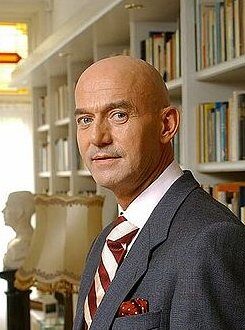
Pim Fortuyn
Pim Fortuyn was a Dutch politician. Born February 19, 1948, in Driehuis. Died May 6, 2002, in Hilversum. Positions held include municipal councillor of Rotterdam. Educated at Mendelcollege and University of Groningen.
Facts
32 facts · 2 confirmed by two sources · 8 cited · 22 from one source
Where this comes from
Papalocal keeps its own record. It started from these sources; what each one said is kept here as it was copied, so a change on their side never changes this page by itself. Tap one to read its version.
What Wikidata says · copied November 16, 2026 · revision 2568191438
- Described as
- Dutch politician (1948–2002)
- Other names
- Wilhelmus Simon Petrus Fortuijn, W.S.P. Fortuyn, Pim Fortuijn
- Born
- February 19, 1948 · 9 references
- Died
- May 6, 2002 · 9 references
- Born in
- Driehuis · 1 reference
- Died in
- Hilversum · 2 references
- Buried in
- San Giorgio della Richinvelda (2002–); Westerveld (2002) · 1 reference
- Cause of death
- gunshot wound
- Name at birth
- Wilhelmus Simon Petrus Fortuijn
- Citizen of
- Kingdom of the Netherlands
- Occupation
- writer; columnist; politician · 1 reference; sociologist · 1 reference; professor; university teacher · 1 reference; political scientist · 1 reference; journalist · 1 reference
- Positions held
- municipal councillor of Rotterdam
- Political party
- Pim Fortuyn List; Labour Party (–1989)
- Worked for
- Maastricht University; University of Groningen; Erasmus University Rotterdam; Nyenrode Business University · 1 reference
- Education
- Mendelcollege; University of Groningen; Vrije Universiteit Amsterdam; University of Amsterdam · 1 reference
- Siblings
- Marten Fortuyn
- Religion
- Catholicism
- Lived in
- Rotterdam
- Website
- http://www.pimfortuyn.com/
- Wikipedias with a page
- 49
Wikidata item Q311697 (wikidata.org/wiki/Q311697), public domain (CC0). Copied November 16, 2026.
What Wikipedia says · copied November 16, 2026 · revision 1385937474
Wilhelmus Simon Petrus Fortuijn, known as Pim Fortuyn (Dutch: [ˈpɪɱ fɔrˈtœyn] ; 19 February 1948 – 6 May 2002) was a Dutch politician, author, civil servant, businessman, sociologist, and academic who founded the party Pim Fortuyn List (Lijst Pim Fortuyn or LPF) in 2002.
Fortuyn worked as an extraordinary professor at the Erasmus University of Rotterdam until 1995 after which he went for a business career and was an advisor to the Dutch government on social infrastructure. He then became prominent in the Netherlands as a press columnist, writer and media commentator.
Initially a Marxist who was sympathetic to the Communist Party of the Netherlands, and later a member of the Dutch Labour Party in the 1970s, Fortuyn's beliefs began to shift to the right in the 1990s, especially related to the immigration policies of the Netherlands. Fortuyn criticised multiculturalism, immigration and Islam in the Netherlands. He called Islam "a backward culture" and was quoted as saying that if it were legally possible, he would close the borders for Muslim immigrants. Fortuyn also supported tougher measures against crime and opposed state bureaucracy, wanting to reduce the Dutch financial contribution to the European Union. He was labelled a far-right populist by his opponents and in the media, but he fiercely rejected this label. Fortuyn was openly gay and a supporter of gay rights.
Fortuyn explicitly distanced himself from "far-right" politicians such as the Belgian Filip Dewinter, Austrian Jörg Haider, or Frenchman Jean-Marie Le Pen whenever compared to them. While he compared his own politics to centre-right politicians such as Silvio Berlusconi of Italy and Edmund Stoiber of Germany, he also admired former Dutch Prime Minister Joop den Uyl, a social democrat, and Democratic U.S. president John F. Kennedy. Fortuyn also criticised the polder model and the policies of the outgoing government of Wim Kok and repeatedly described himself and LPF's ideology as pragmatic and not populistic. He also became known for his unconventional and flamboyant way of debating which was considered unique in Dutch politics at the time. In March 2002, his newly created LPF became the largest party in Fortuyn's hometown Rotterdam during the Dutch municipal elections held that year.
Fortuyn was assassinated during the 2002 Dutch national election campaign by Volkert van der Graaf, a left-wing environmentalist and animal rights activist. In court at his trial, Van der Graaf said he murdered Fortuyn to stop him from exploiting Muslims as "scapegoats" and targeting "the weak members of society" in seeking political power. The LPF went on to poll in second place during the election but went into decline soon after before it was ultimately disbanded at a national level in 2008. Despite this, Fortuyn's ideas and legacy continued to have an impact upon Dutch politics. Observers have described his ideological influence as Fortuynism or the Fortuyn revolt.
- Born, in its opening lines
- February 19, 1948
- Died, in its opening lines
- May 6, 2002
From the Wikipedia article “Pim Fortuyn” (en.wikipedia.org/wiki/Pim_Fortuyn), by its contributors, under CC BY-SA 4.0 (creativecommons.org/licenses/by-sa/4.0/). Copied November 16, 2026; not changed.
Confirmed Two sources agree. Cited One source, and it names where it got it. One source One source, without a reference of its own. Sources disagree The sources disagree. We show the best-supported value and keep theirs below.
