
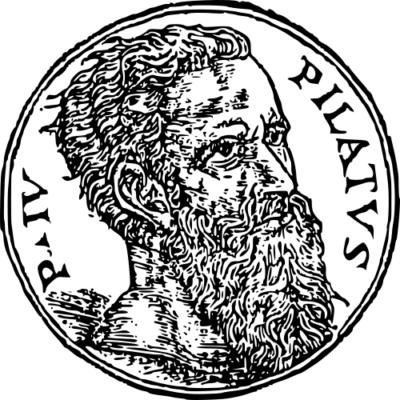
Pontius Pilatus
Pontius Pilatus was a fifth Prefect of the Roman province of Judaea, from AD 26–36. Born December 12 BC, in Abruzzo. Positions held include prefect of Judea (26–36).
Facts
9 facts · 0 confirmed by two sources · 2 cited · 7 from one source
Where this comes from
Papalocal keeps its own record. It started from these sources; what each one said is kept here as it was copied, so a change on their side never changes this page by itself. Tap one to read its version.
What Wikidata says · copied November 16, 2026 · revision 2565545249
- Described as
- fifth Prefect of the Roman province of Judaea, from AD 26–36
- Other names
- Pontius Pilate, Pilatus, Pilate, Marcus Pontius Pilatus
- Born
- December 12 BC · 1 reference
- Born in
- Abruzzo
- Citizen of
- Ancient Rome
- Occupation
- politician; official
- Positions held
- prefect of Judea (26–36)
- Spouse
- Pontius Pilate's wife · 1 reference
- Military branch
- Roman army · 1 reference
- Military rank
- legatus · 1 reference
- Wikipedias with a page
- 98
Wikidata item Q17131 (wikidata.org/wiki/Q17131), public domain (CC0). Copied November 16, 2026.
What Wikipedia says · copied November 16, 2026 · revision 1385271598
Pontius Pilate (Latin: Pontius Pilatus; Ancient Greek: Πόντιος Πιλᾶτος, romanized: Póntios Pilâtos) was the fifth governor of the Roman province of Judaea, serving under Emperor Tiberius from 26/27 to 36/37 AD. He is best known for being the official who presided over the trial of Jesus and ultimately ordered his crucifixion. Pilate's importance in Christianity is underscored by his prominent place in both the Apostles' and Nicene Creeds. Because the gospels portray Pilate as reluctant to execute Jesus, the Ethiopian Orthodox Tewahedo Church believes that Pilate became a Christian and venerates him as both a martyr and a saint.
Pontius Pilate is the best-attested figure to hold the position of Roman governor of Judaea, though few sources about his rule have survived. Virtually nothing is known about his life prior to becoming governor or the circumstances of his appointment. Surviving evidence includes coins he minted and the Pilate Stone inscription. Ancient sources such as Josephus, Philo, and the Gospel of Luke document several incidents of conflict between Pilate and the Jewish population, often citing his insensitivity to Jewish religious customs. The Christian gospels, as well as Josephus and Tacitus, attribute the crucifixion of Jesus to Pilate's orders.
Josephus reports that Pilate was dismissed after violently quelling a Samaritan uprising at Mount Gerizim. He was ordered to Rome by the Syrian legate to face Emperor Tiberius, but Tiberius died before Pilate arrived, and his fate thereafter remains unknown. Some early sources, including Celsus and Origen, suggest he retired. Modern historians are divided on Pilate's governance, with some viewing him as brutal and inept, while others point to his relatively long tenure as evidence of moderate competence. A once-prominent theory attributing Pilate's actions to antisemitism is now largely rejected.
In Late Antiquity and the Middle Ages, Pilate became a prominent figure in Christian apocryphal literature known as the "Pilate cycle". Eastern traditions often depicted him and his wife as Christian converts and even saints, while Western texts portrayed him negatively, frequently linking his death to suicide and associating his burial site with cursed locations. Pilate has appeared extensively in art, especially in depictions of Jesus's trial. In medieval passion plays, his character varied from reluctant judge to malevolent villain. He has been portrayed in modern literature and film, with notable literary treatments by Anatole France, Mikhail Bulgakov, and Chingiz Aitmatov. He received increased literary attention following World War II.
From the Wikipedia article “Pontius Pilate” (en.wikipedia.org/wiki/Pontius_Pilate), by its contributors, under CC BY-SA 4.0 (creativecommons.org/licenses/by-sa/4.0/). Copied November 16, 2026; not changed.
Confirmed Two sources agree. Cited One source, and it names where it got it. One source One source, without a reference of its own. Sources disagree The sources disagree. We show the best-supported value and keep theirs below.
