
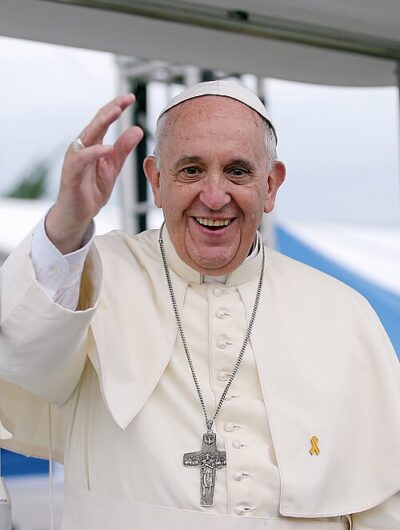
Pope Francis
Pope Francis was the 266th pope of the Catholic Church from 2013 to 2025. Born December 17, 1936, in Flores. Died April 21, 2025, in Domus Sanctae Marthae. Positions held include Pope (2013–2025), auxiliary bishop (1992–1997) and coadjutor archbishop (1997–1998). Known for Ad charisma tuendum. Educated at Facultades de Filosofía y Teología de San Miguel and Inmaculada Concepción Seminary. Awards include Charlemagne Prize, Grand Collar of the Order of the Andes' Condor and Bambi Award.
Facts
57 facts · 2 confirmed by two sources · 26 cited · 28 from one source · 1 where the sources disagree
What’s different
- Cause of death: we show stroke (Sources disagree). Wikidata also lists circulatory collapse
Where this comes from
Papalocal keeps its own record. It started from these sources; what each one said is kept here as it was copied, so a change on their side never changes this page by itself. Tap one to read its version.
What Wikidata says · copied November 16, 2026 · revision 2567210530
- Described as
- 266th pope of the Catholic Church from 2013 to 2025 (1936–2025)
- Other names
- Francisco, Pope Francis I, Franciscus I, François Bergoglio, Francis, Pope Franciscus, Pope Francesco, Pope Francisco, Jorge Mario Bergoglio, Jorge Mario Bergoglio Sivori, Jorge Bergoglio, papa Francesco
- Born
- December 17, 1936 · 8 references
- Died
- April 21, 2025 · 6 references
- Born in
- Flores · 2 references
- Died in
- Domus Sanctae Marthae · 1 reference
- Buried in
- Basilica di Santa Maria Maggiore
- Cause of death
- stroke · 2 references; circulatory collapse · 1 reference
- Name at birth
- Jorge Mario Bergoglio
- Citizen of
- Vatican City · 1 reference; Argentina · 2 references
- Occupation
- Latin Catholic priest (1969–2025) · 1 reference; writer · 2 references; preacher; Latin Catholic bishop (1992–2025) · 1 reference; politician · 1 reference; chemical technologist · 1 reference; autobiographer · 1 reference; Catholic theologian · 2 references
- Positions held
- Pope (2013–2025) · 3 references; auxiliary bishop (1992–1997) · 1 reference; coadjutor archbishop (1997–1998) · 1 reference; cardinal priest (2001–2013) · 1 reference; Archbishop of Buenos Aires (1998–2013) · 2 references; titular bishop (1992–1997) · 1 reference; diocesan bishop (1998–2013) · 2 references; Patriarch of the West (2013–2025); Provincial of the Jesuits of Argentina and Uruguay (1973–1979); President of the Episcopal Conference of Argentina (2005–2011)
- Education
- Facultades de Filosofía y Teología de San Miguel; Inmaculada Concepción Seminary · 1 reference; Colegio Máximo de San José · 1 reference; Sankt Georgen Graduate School of Philosophy and Theology · 1 reference
- Member of
- Romanian Academy
- Known for
- Ad charisma tuendum (2022)
- Awards
- Charlemagne Prize (2016); Grand Collar of the Order of the Andes' Condor (2015); Bambi Award (2016) · 1 reference; Order of the Smile; Time Person of the Year (2013) · 1 reference; Sexist Man Alive (2021) · 1 reference; Supreme Order of Christ · 1 reference; Order of the Golden Spur · 1 reference; Order of Pius IX · 1 reference; Order of St. Gregory the Great · 1 reference; Order of St. Sylvester · 1 reference; Equestrian Order of the Holy Sepulchre · 1 reference; Presidential Medal of Freedom (2025) · 1 reference; Gold Olympic Order (2013); Zayed Award for Human Fraternity (2019)
- Field
- Christian literature · 1 reference; Petrine ministry · 1 reference; Christian education · 1 reference
- Father
- Mario José Bergoglio · 1 reference
- Mother
- Regina María Sívori · 1 reference
- Siblings
- María Elena Bergoglio; Óscar Adrián Bergoglio Sívori
- Religion
- Catholicism · 1 reference
- Website
- https://www.vatican.va/content/francesco/en.html
- Wikipedias with a page
- 239
Wikidata item Q450675 (wikidata.org/wiki/Q450675), public domain (CC0). Copied November 16, 2026.
What Wikipedia says · copied November 16, 2026 · revision 1385226568
Pope Francis (born Jorge Mario Bergoglio; 17 December 1936 – 21 April 2025) was the head of the Catholic Church and sovereign of Vatican City from his election in 2013 until his death in 2025. He was the first Jesuit pope, the first Latin American, and the first pope born or raised outside Europe since the 8th-century Syrian pope Gregory III.
Born and raised in Buenos Aires, Argentina, to a family of Italian origin, Bergoglio was inspired to join the Jesuits in 1958 after recovering from a severe illness. He was ordained a Catholic priest in 1969, and from 1973 to 1979 he was the Jesuit provincial superior in Argentina. He became the archbishop of Buenos Aires in 1998 and was created a cardinal in 2001 by Pope John Paul II. Following the resignation of Pope Benedict XVI, the 2013 papal conclave elected Bergoglio as pope on 13 March. He chose Francis as his papal name in honor of Francis of Assisi.
Throughout his papacy, Francis was noted for his humility, emphasis on God's mercy, international visibility, commitment to interreligious dialogue, and concern for the poor, migrants, and refugees. He made women and laymen full members of dicasteries in the Roman Curia. He believed the Catholic Church should demonstrate more inclusivity to LGBTQ people, and permitted non-liturgical blessings of individuals in same-sex relationships in the Latin Church. He also convened the Synod on Synodality, which was described as the culmination of his papacy and the most important event in the Catholic Church since the Second Vatican Council. He was well known for having a less formal approach to the papacy than his predecessors by, for instance, choosing to reside in the Domus Sanctae Marthae guesthouse rather than in the papal apartments of the Apostolic Palace used by previous popes. In addition, due to both his Jesuit and Ignatian aesthetic, he was known for favoring simpler vestments devoid of ornamentation, including refusing the traditional papal mozzetta cape upon his election, choosing silver instead of gold for his piscatory ring, and keeping the same iron pectoral cross he had as cardinal.
Concerning global governance, Francis was a critic of trickle-down economics, consumerism, and overdevelopment; he made action on climate change a leading focus of his papacy. He viewed capital punishment as inadmissible in all cases, and committed the Catholic Church to its worldwide abolition. Francis criticized the rise of right-wing populism and anti-immigration politics, calling the protection of migrants a "duty of civilization", and called for the decriminalization of homosexuality. In international diplomacy, he also helped to restore diplomatic relations between Cuba and the United States, negotiated a deal with China to define Communist Party influence in appointing Chinese bishops, and encouraged peace between Israel and Palestinians, signing the Vatican's first treaty with Palestine and condemning Israel's military operations in Gaza, as well as calling for investigations of war crimes. In 2022, he apologized for the Church's role in the Canadian Indian residential school system. Following a period of declining health and multiple scares, Francis made his last public appearance on Easter Sunday before dying on 21 April 2025, Easter Monday. The 2025 conclave elected Leo XIV as Francis's successor on 8 May, becoming the second pope from the Americas, after Francis.
- Born, in its opening lines
- December 17, 1936
- Died, in its opening lines
- April 21, 2025
From the Wikipedia article “Pope Francis” (en.wikipedia.org/wiki/Pope_Francis), by its contributors, under CC BY-SA 4.0 (creativecommons.org/licenses/by-sa/4.0/). Copied November 16, 2026; not changed.
Confirmed Two sources agree. Cited One source, and it names where it got it. One source One source, without a reference of its own. Sources disagree The sources disagree. We show the best-supported value and keep theirs below.
