
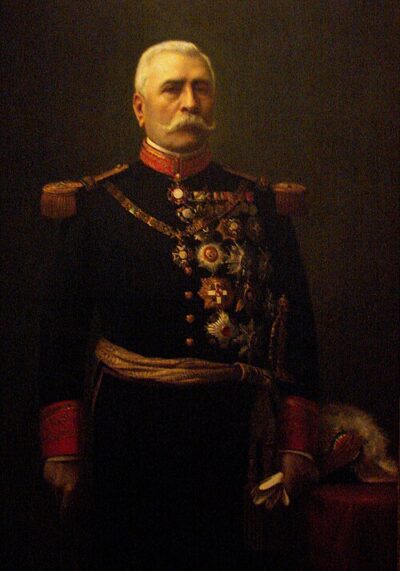
Porfirio Díaz
Porfirio Díaz was a President of Mexico. Born September 15, 1830, in Oaxaca de Juárez. Died July 2, 1915, in Paris. Positions held include President of Mexico (1884–1911), minister and Member of the Chamber of Deputies of Mexico. Educated at Instituto de Ciencias y Artes de Oaxaca. Awards include Knight Grand Cross of the Order of the Bath, Grand Cross of the Order of Isabella the Catholic and Knight Grand Cross of the Order of Saint Stephen of Hungary.
Facts
38 facts · 2 confirmed by two sources · 16 cited · 20 from one source
Where this comes from
Papalocal keeps its own record. It started from these sources; what each one said is kept here as it was copied, so a change on their side never changes this page by itself. Tap one to read its version.
What Wikidata says · copied November 16, 2026 · revision 2568868210
- Described as
- President of Mexico (1830–1915)
- Other names
- Porfirio Diaz, José de la Cruz Porfirio Diaz Mori, José de la Cruz Porfirio Díaz Mori
- Born
- September 15, 1830 · 12 references
- Died
- July 2, 1915 · 12 references
- Born in
- Oaxaca de Juárez · 2 references
- Died in
- Paris · 3 references
- Buried in
- Montparnasse Cemetery
- Name at birth
- José de la Cruz Porfirio Díaz Mori
- Citizen of
- Mexico
- Occupation
- politician · 1 reference; military personnel
- Positions held
- President of Mexico (1884–1911); minister; Member of the Chamber of Deputies of Mexico
- Political party
- Liberal Party
- Education
- Instituto de Ciencias y Artes de Oaxaca
- Awards
- Knight Grand Cross of the Order of the Bath (1906) · 1 reference; Grand Cross of the Order of Isabella the Catholic; Knight Grand Cross of the Order of Saint Stephen of Hungary (1901) · 1 reference; Grand Cordon of the Order of Leopold (1896) · 1 reference; Knight Grand Cross of the Order of Saints Maurice and Lazarus (1893) · 1 reference; Knight Grand Cross in the Order of the Netherlands Lion (1908) · 1 reference; Grand Collar of the Order of the Tower and Sword (1887) · 1 reference; Knight Grand Cross of the Order of the Sword (1886) · 1 reference; Order of the Liberator (1887) · 1 reference; Grand Cross of the Order of Charles III (1886) · 1 reference; Order of the Red Eagle 1st Class (1896) · 1 reference; Grand Cordon of the Supreme Order of the Chrysanthemum (1892) · 1 reference; Collar of the Supreme Order of the Chrysanthemum · 1 reference; Grand Cross of the Legion of Honour (1888) · 1 reference; Order of the Lion and the Sun First class (1902) · 1 reference
- Spouse
- Delfina Ortega Díaz (1867–1880); Carmen Romero Rubio (1881–) · 1 reference
- Children
- Amada Díaz; Porfirio Díaz Ortega; Luz Aurora Victoria Díaz Ortega
- Siblings
- Félix Díaz Mori
- Religion
- Catholic Church
- Military branch
- Mexican Army · 1 reference
- Military rank
- general
- Wikipedias with a page
- 81
Wikidata item Q150688 (wikidata.org/wiki/Q150688), public domain (CC0). Copied November 16, 2026.
What Wikipedia says · copied November 16, 2026 · revision 1384404256
José de la Cruz Porfirio Díaz Mori (; Spanish: [poɾˈfiɾjo ˈði.as]; baptized 15 September 1830 – 2 July 1915), commonly known as Porfirio Díaz, was a Mexican army general and politician who was the leader of Mexico from 1876, and the actual dictator after 1886 until his overthrow in 1911. Seizing power in a military coup, he served on three occasions as president of Mexico, a total of over thirty years, the longest of any Mexican ruler. This period is known as the Porfiriato and has been called a de facto dictatorship.
Díaz was born to a Oaxacan family of modest means. He initially studied to become a priest but eventually switched his studies to law, and among his mentors was the future President of Mexico, Benito Juárez. Díaz increasingly became active in Liberal Party politics fighting with the Liberals to overthrow Santa Anna in the Plan of Ayutla, and also fighting on their side against the Conservative Party in the Reform War.
During the second French intervention in Mexico, Díaz fought in the Battle of Puebla in 1862, which temporarily repulsed the invaders, but was captured when the French besieged the city with reinforcements a year later. He escaped captivity and made his way to Oaxaca de Juárez, becoming political and military commander over all of Southern Mexico, and successfully resisting French efforts to advance upon the region, until Oaxaca City fell before a French siege in 1865. Díaz once more escaped captivity seven months later and rejoined the army of the Mexican Republic as the Second Mexican Empire disintegrated in the wake of the French departure. As Emperor Maximilian made a last stand in Querétaro, Díaz was in command of the forces that took back Mexico City in June 1867.
During the era of the Restored Republic, he subsequently revolted against presidents Benito Juárez and Sebastián Lerdo de Tejada on the principle of no re-election. Díaz succeeded in seizing power, ousting Lerdo in a coup in 1876, with the help of his political supporters, and was elected in 1877. In 1880, he stepped down and his political ally Manuel González was elected president, serving from 1880 to 1884. In 1884, Díaz abandoned the idea of no re-election and held office continuously until 1911.
A controversial figure in Mexican history, Díaz's regime ended political instability and achieved growth after decades of economic stagnation. He and his allies comprised a group of technocrats known as científicos ("scientists"), whose economic policies benefited a circle of allies and foreign investors, helping hacendados consolidate large estates, often through violent means and legal abuse. These policies grew increasingly unpopular, resulting in civil repression and regional conflicts, as well as strikes and uprisings from labor and the peasantry, groups that did not share in Mexico's growth.
Despite public statements in 1908 favoring a return to democracy and not running again for office, Díaz reversed himself and ran in the 1910 election. Díaz, then 80 years old, failed to institutionalize presidential succession, triggering a political crisis between the científicos and the followers of General Bernardo Reyes, allied with the military and peripheral regions of Mexico. After Díaz declared himself the winner for an eighth term, his electoral opponent, wealthy estate owner Francisco I. Madero, issued the Plan of San Luis Potosí calling for armed rebellion against Díaz, leading to the outbreak of the Mexican Revolution. In May 1911, after the Federal Army suffered several defeats against the forces supporting Madero, Díaz resigned in the Treaty of Ciudad Juárez and went into exile in Paris, where he died four years later.
- Born, in its opening lines
- September 15, 1830
- Died, in its opening lines
- July 2, 1915
From the Wikipedia article “Porfirio Díaz” (en.wikipedia.org/wiki/Porfirio_Díaz), by its contributors, under CC BY-SA 4.0 (creativecommons.org/licenses/by-sa/4.0/). Copied November 16, 2026; not changed.
Confirmed Two sources agree. Cited One source, and it names where it got it. One source One source, without a reference of its own. Sources disagree The sources disagree. We show the best-supported value and keep theirs below.
