
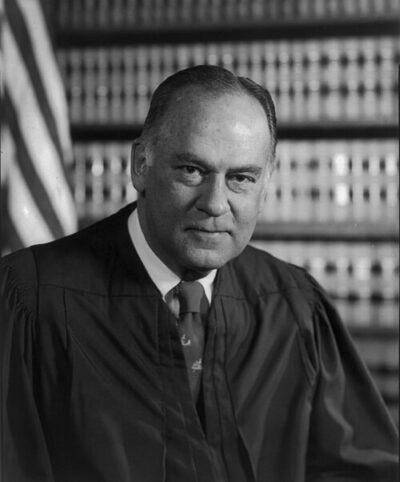
Potter Stewart
Potter Stewart was an US Supreme Court justice from 1958 to 1981. Born January 23, 1915, in Jackson. Died December 7, 1985, in Hanover. Positions held include Associate Justice of the Supreme Court of the United States (1958–1981) and Judge of the United States Court of Appeals for the Sixth Circuit (1954–1958). Educated at Yale Law School and Hotchkiss School.
Facts
18 facts · 2 confirmed by two sources · 5 cited · 11 from one source
Where this comes from
Papalocal keeps its own record. It started from these sources; what each one said is kept here as it was copied, so a change on their side never changes this page by itself. Tap one to read its version.
What Wikidata says · copied November 16, 2026 · revision 2473614447
- Described as
- US Supreme Court justice from 1958 to 1981 (1915-1985)
- Born
- January 23, 1915 · 2 references
- Died
- December 7, 1985 · 2 references
- Born in
- Jackson · 1 reference
- Died in
- Hanover
- Buried in
- Arlington National Cemetery (1985) · 1 reference
- Cause of death
- stroke
- Citizen of
- United States
- Occupation
- judge · 1 reference; politician
- Positions held
- Associate Justice of the Supreme Court of the United States (1958–1981); Judge of the United States Court of Appeals for the Sixth Circuit (1954–1958)
- Political party
- Republican Party
- Education
- Yale Law School · 1 reference; Hotchkiss School; Berkeley College
- Member of
- Phi Beta Kappa Society
- Mother
- Harriet Loomis Potter · 1 reference
- Religion
- Episcopal Church
- Wikipedias with a page
- 20
Wikidata item Q1359993 (wikidata.org/wiki/Q1359993), public domain (CC0). Copied November 16, 2026.
What Wikipedia says · copied November 16, 2026 · revision 1384404675
Potter Stewart (January 23, 1915 – December 7, 1985) was an American lawyer and judge who was an associate justice of the United States Supreme Court from 1958 to 1981. During his tenure, he made major contributions to criminal justice reform, civil rights, access to the courts, and Fourth Amendment jurisprudence.
After graduating from Yale Law School in 1941, Stewart served in World War II as a member of the United States Navy Reserve. After the war, he practiced law and served on the Cincinnati city council. In 1954, President Dwight D. Eisenhower appointed Stewart to a judgeship on the U.S. Court of Appeals for the Sixth Circuit. In 1958, Eisenhower nominated Stewart, as a recess appointment, to succeed retiring Associate Justice Harold Hitz Burton, and Stewart won Senate confirmation afterwards. He was frequently in the minority during the Warren Court but emerged as a centrist swing vote on the Burger Court. Stewart retired in 1981 and was succeeded by the first female United States Supreme Court justice, Sandra Day O'Connor.
Stewart wrote the majority opinion in cases such as Jones v. Alfred H. Mayer Co., Katz v. United States, Chimel v. California, and Sierra Club v. Morton. He wrote dissenting opinions in cases such as Engel v. Vitale, In re Gault and Griswold v. Connecticut. He popularized the phrase "I know it when I see it" with a concurring opinion in Jacobellis v. Ohio, in which a theater owner had been fined for showing a supposedly obscene film. Upon announcing his retirement in 1981, when asked if he had any regrets from his time on the Court, he humorously lamented "In a way, I regret having once said about obscenity 'I know it when I see it' because I think that's gonna be on my tombstone."
- Born, in its opening lines
- January 23, 1915
- Died, in its opening lines
- December 7, 1985
From the Wikipedia article “Potter Stewart” (en.wikipedia.org/wiki/Potter_Stewart), by its contributors, under CC BY-SA 4.0 (creativecommons.org/licenses/by-sa/4.0/). Copied November 16, 2026; not changed.
Confirmed Two sources agree. Cited One source, and it names where it got it. One source One source, without a reference of its own. Sources disagree The sources disagree. We show the best-supported value and keep theirs below.
