
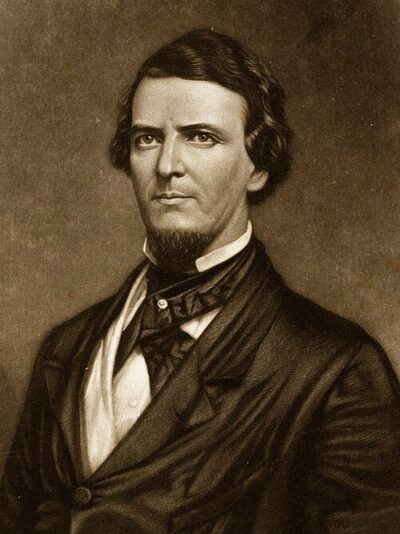
Preston Brooks
Preston Brooks was a South Carolina politician.. Born August 5, 1819, in Edgefield. Died January 27, 1857, in Washington, D.C.. Positions held include United States representative and member of the South Carolina House of Representatives. Educated at University of South Carolina.
Facts
12 facts · 2 confirmed by two sources · 2 cited · 7 from one source · 1 where the sources disagree
What’s different
- Born: we show August 5, 1819 (Confirmed). Wikidata also lists August 6, 1819
- Buried in: we show Edgefield (Sources disagree). Wikidata also lists South Carolina
Where this comes from
Papalocal keeps its own record. It started from these sources; what each one said is kept here as it was copied, so a change on their side never changes this page by itself. Tap one to read its version.
What Wikidata says · copied November 18, 2026 · revision 2528336700
- Described as
- South Carolina politician. (1819–1857)
- Other names
- Preston Smith Brooks
- Born
- August 5, 1819 · 2 references; August 6, 1819 · 1 reference
- Died
- January 27, 1857 · 3 references
- Born in
- Edgefield
- Died in
- Washington, D.C.
- Buried in
- South Carolina; Edgefield · 1 reference
- Citizen of
- United States
- Occupation
- politician · 1 reference; lawyer · 1 reference
- Positions held
- United States representative; member of the South Carolina House of Representatives
- Political party
- Democratic Party
- Education
- University of South Carolina
- Wikipedias with a page
- 19
Wikidata item Q1590822 (wikidata.org/wiki/Q1590822), public domain (CC0). Copied November 18, 2026.
What Wikipedia says · copied November 18, 2026 · revision 1353730271
Preston Smith Brooks (August 5, 1819 – January 27, 1857) was an American slaveholder, politician, and member of the U.S. House of Representatives from South Carolina, serving as a member of the Democratic Party from 1853 until his resignation in July 1856 and again from August 1856 until his death.
He is most remembered for his May 22, 1856, attack upon abolitionist and Republican Senator Charles Sumner, whom he beat nearly to death with a cane on the floor of the United States Senate in retaliation for an anti-slavery speech in which Sumner verbally insulted Brooks's first cousin once removed, South Carolina Senator Andrew Butler.
Brooks' beating seriously injured Sumner, who was unable to return to the Senate for three years. The Massachusetts Legislature reelected Sumner in 1856 "and let his seat sit vacant during his absence as a reminder of Southern brutality".
An attempt to oust Brooks from the House of Representatives failed, and he received only token punishment in his criminal trial. He resigned his seat in July 1856 to allow his constituents to express their view on his conduct; they reelected him in the August special election to fill the vacancy created by his resignation. He was reelected to a full term in November 1856, but died in January 1857, five weeks before the new term began in March.
As described by historian Stephen Puleo, "The caning had an enormous impact on the events that followed over the next four years. ... As a result of the caning, the country was pushed, inexorably and unstoppably, to civil war."
- Born, in its opening lines
- August 5, 1819
- Died, in its opening lines
- January 27, 1857
From the Wikipedia article “Preston Brooks” (en.wikipedia.org/wiki/Preston_Brooks), by its contributors, under CC BY-SA 4.0 (creativecommons.org/licenses/by-sa/4.0/). Copied November 18, 2026; not changed.
Confirmed Two sources agree. Cited One source, and it names where it got it. One source One source, without a reference of its own. Sources disagree The sources disagree. We show the best-supported value and keep theirs below.
