
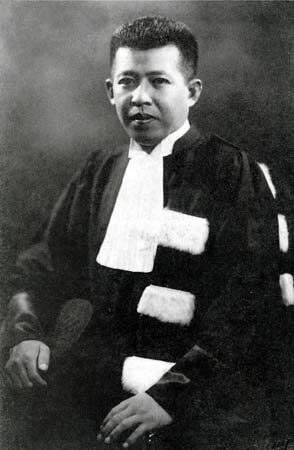
Pridi Banomyong
Pridi Banomyong was a Thai prime minister. Born May 11, 1900, in Phra Nakhon Si Ayutthaya. Died May 2, 1983, in Antony. Positions held include Prime Minister of Thailand (1946) and Minister of Finance of Thailand (1946). Educated at University of Paris and Ayutthaya Wittayalai School. Awards include Grand Cross of the Legion of Honour, Knight Grand Cross of the Order of St Michael and St George and Order of the Rising Sun, 1st class.
Facts
31 facts · 2 confirmed by two sources · 5 cited · 24 from one source
Where this comes from
Papalocal keeps its own record. It started from these sources; what each one said is kept here as it was copied, so a change on their side never changes this page by itself. Tap one to read its version.
What Wikidata says · copied November 16, 2026 · revision 2562762036
- Described as
- Thai prime minister (1900-1983)
- Born
- May 11, 1900 · 2 references
- Died
- May 2, 1983 · 3 references
- Born in
- Phra Nakhon Si Ayutthaya · 1 reference
- Died in
- Antony · 1 reference
- Buried in
- Wat Phra Si Mahathat · 1 reference
- Citizen of
- Thailand
- Occupation
- statesperson; lawyer; screenwriter; jurist · 1 reference; head of government · 1 reference; politician · 1 reference
- Positions held
- Prime Minister of Thailand (1946); Minister of Finance of Thailand (1946) · 1 reference
- Education
- University of Paris; Ayutthaya Wittayalai School
- Awards
- Grand Cross of the Legion of Honour; Knight Grand Cross of the Order of St Michael and St George; Order of the Rising Sun, 1st class; Grand Cordon of the Order of Leopold; Knight Grand Cross of the Order of Vasa; Order of the German Eagle; Order of the Nine Gems; Order of Chula Chom Klao; Order of the White Elephant; Order of the Crown of Thailand; Knight Grand Cross of the Order of Saints Maurice and Lazarus; Medal of Freedom
- Spouse
- Poonsuk Banomyong · 1 reference
- Siblings
- Paan Phanomyong · 1 reference; Doochsadee Buntasnakul · 1 reference
- Wikipedias with a page
- 67
Wikidata item Q714934 (wikidata.org/wiki/Q714934), public domain (CC0). Copied November 16, 2026.
What Wikipedia says · copied November 16, 2026 · revision 1373149174
Pridi Banomyong (Thai: ปรีดี พนมยงค์, RTGS: Pridi Phanomyong, pronounced [prīː.dīː pʰā.nōm.jōŋ]; 11 May 1900 – 2 May 1983), also known by his noble title Luang Praditmanutham (Thai: หลวงประดิษฐ์มนูธรรม), was a Thai lawyer, professor, activist, politician, democratic socialist, and senior statesman. He served in multiple ministerial posts, as regent, and as prime minister in Thailand. He led the civilian wing of Khana Ratsadon, and helped found the University of Moral and Political Sciences and the Bank of Thailand.
Born to a family of farmers in Ayutthaya province, he received a good education, becoming one of the nation's youngest barristers in 1919, at the age of nineteen. In 1920, he won a royal scholarship granted by the King of Siam to study in France, where he graduated from the University of Caen with a master's degree, and received a doctorate from the University of Paris in 1927. In the same year, he co-founded Khana Ratsadon with like-minded Siamese overseas royal-sponsored students. After returning to Thailand, still called Siam at the time, he worked as a judge, judicial secretariat, and professor. In the aftermath of 1932 Siamese Revolution, he played an important role in drafting two of the country's first constitutions and proposing a socialist economic plan influenced by communism scheme, principles and conducts. His plan was ill-received, and Pridi went into a short period of political exile as aftermath of the fight-for-power with his fellow revolutionists. On his return, he took many ministerial posts in Khana Ratsadon governments. His contributions include modernizing Thai legal codes, laying the foundation for Thailand's local government system, negotiating the cancellation of unequal treaties with the West, and tax reform.
Pridi diverged from Plaek Phibunsongkhram after the latter began to display a taste for dictatorial governance in the 1930s, marking the beginning of the long rivalry between the two Khana Ratsadon leaders. Pridi was made Regent during 1941 to 1945, a powerless post at the time. Shortly thereafter, he became leader of the domestic Free Thai Movement during World War II. He briefly became prime minister in 1946, but his political opponents painted him as the mastermind behind the mysterious death of King Ananda Mahidol, and a coup in 1947 cost him his political power. An attempt to stage a counter-coup in 1949 failed and Pridi spent the rest of his life living in exile. He died in Paris in 1983, and his ashes were brought back to Thailand three years later.
He is often described as a democratic socialist. The branding of Pridi as a communist and a mastermind of King Ananda's death has since been regarded as politically motivated, which his opponents continued to use even after his death. However, Pridi won every libel lawsuit in Thailand filed against those who promoted such views. He became a symbol of resistance against military dictatorships, Progressive politics, and Thammasat University. The centenary of his birth was celebrated by UNESCO in 2000.
- Born, in its opening lines
- May 11, 1900
- Died, in its opening lines
- May 2, 1983
From the Wikipedia article “Pridi Banomyong” (en.wikipedia.org/wiki/Pridi_Banomyong), by its contributors, under CC BY-SA 4.0 (creativecommons.org/licenses/by-sa/4.0/). Copied November 16, 2026; not changed.
Confirmed Two sources agree. Cited One source, and it names where it got it. One source One source, without a reference of its own. Sources disagree The sources disagree. We show the best-supported value and keep theirs below.
