
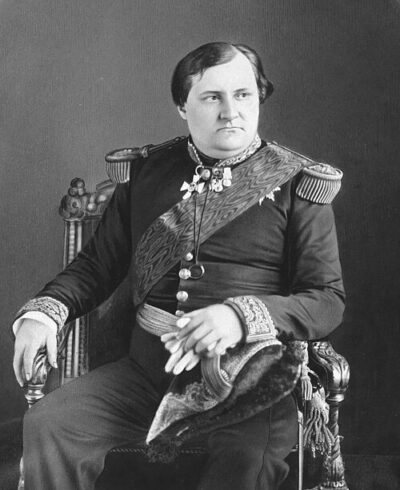
Prince Napoléon-Jérôme, Prince Napoléon
Prince Napoléon-Jérôme, Prince Napoléon was a Napoleon's nephew. Born September 9, 1822, in Trieste. Died March 17, 1891, in Rome. Positions held include Member of the 1848 Constituent Assembly (1848–1849), Second Empire senator and minister. Awards include Grand Cross of the Legion of Honour, Gold Medal of Military Valour and Royal Order of the Seraphim.
Facts
31 facts · 2 confirmed by two sources · 16 cited · 13 from one source
Where this comes from
Papalocal keeps its own record. It started from these sources; what each one said is kept here as it was copied, so a change on their side never changes this page by itself. Tap one to read its version.
What Wikidata says · copied November 16, 2026 · revision 2567895077
- Described as
- Napoleon's nephew (1822–1891)
- Other names
- Napoléon-Jérôme Bonaparte, Napoleon Joseph Charles Paul Bonaparte, Napoleon-Jerome Bonaparte, Plon-Plon
- Born
- September 9, 1822 · 9 references
- Died
- March 17, 1891 · 4 references
- Born in
- Trieste · 2 references
- Died in
- Rome · 2 references
- Buried in
- Basilica of Superga
- Citizen of
- France
- Occupation
- politician · 1 reference; diplomat · 1 reference
- Positions held
- Member of the 1848 Constituent Assembly (1848–1849) · 1 reference; Second Empire senator · 1 reference; minister; Deputy of the French Second Republic (1849–1851) · 1 reference; Deputy of the French Third Republic (1876–1877) · 1 reference
- Member of
- Académie des beaux-arts
- Awards
- Grand Cross of the Legion of Honour (1853–) · 1 reference; Gold Medal of Military Valour; Royal Order of the Seraphim; Order of the Elephant · 1 reference
- Field
- politics · 1 reference; diplomacy · 1 reference; military campaign · 1 reference
- Spouse
- Princess Maria Clotilde of Savoy (1859–) · 1 reference
- Children
- Princess Maria Letizia, Duchess of Aosta; Victor, Prince Napoléon · 1 reference; Prince Louis Bonaparte · 1 reference
- Father
- Jérôme Bonaparte · 1 reference
- Mother
- Catharina of Württemberg
- Siblings
- Mathilde Bonaparte; Jérôme Napoléon Charles Bonaparte
- Military rank
- divisional general · 1 reference; general · 1 reference
- Wikipedias with a page
- 31
Wikidata item Q434077 (wikidata.org/wiki/Q434077), public domain (CC0). Copied November 16, 2026.
What Wikipedia says · copied November 16, 2026 · revision 1385836351
Prince Napoléon Joseph Charles Paul Bonaparte (9 September 1822 – 17 March 1891), usually called Napoléon-Jérôme Bonaparte or Jérôme Bonaparte, was the second son of Jérôme, King of Westphalia, youngest brother of Napoleon I, and his second wife Catharina of Württemberg. Following the death of his cousin Louis-Napoléon, Prince Imperial in 1879, he claimed headship of the House of Bonaparte until his death in 1891. An outspoken liberal however, he was passed over as heir in his cousin's final will, which instead chose his elder son Victor, who was favored by most Bonapartists. From the 1880s onwards, he was one of the stronger supporters of General Georges Boulanger, together with other monarchist forces.
As well as bearing the title of Prince Napoléon, given to him by his cousin Emperor Napoleon III in 1852,
he was also 2nd Prince of Montfort, 1st Count of Meudon and Count of Moncalieri, following his marriage with Maria Clotilde of Savoy in 1859. His popular nickname, Plon-Plon, stemmed from his difficulty in pronouncing his own name while still a child, although other notable historians and contemporary letters by his nephew Colonel Jérôme Bonaparte claim it was because he ran in cowardice during battle when the bombs fell. Another nickname, "Craint-Plomb" ("Afraid-of-Lead",) was given to him by the army due to his absence from the Battle of Solferino.
- Born, in its opening lines
- September 9, 1822
- Died, in its opening lines
- March 17, 1891
From the Wikipedia article “Prince Napoléon-Jérôme Bonaparte” (en.wikipedia.org/wiki/Prince_Napoléon-Jérôme_Bonaparte), by its contributors, under CC BY-SA 4.0 (creativecommons.org/licenses/by-sa/4.0/). Copied November 16, 2026; not changed.
Confirmed Two sources agree. Cited One source, and it names where it got it. One source One source, without a reference of its own. Sources disagree The sources disagree. We show the best-supported value and keep theirs below.
