
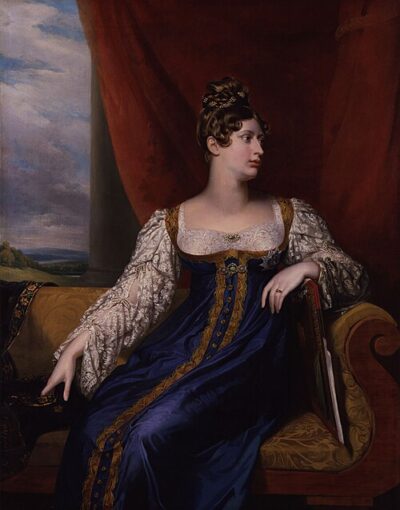
Princess Charlotte Augusta of Wales
Princess Charlotte Augusta of Wales was a British princess (1796-1817); only child of George, Prince of Wales (later King George IV). Born January 7, 1796, in Carlton House. Died November 6, 1817, in Claremont. Awards include Dame Grand Cordon of the Order of Saint Catherine.
Facts
20 facts · 2 confirmed by two sources · 4 cited · 14 from one source
Where this comes from
Papalocal keeps its own record. It started from these sources; what each one said is kept here as it was copied, so a change on their side never changes this page by itself. Tap one to read its version.
What Wikidata says · copied November 16, 2026 · revision 2569122994
- Described as
- British princess (1796-1817); only child of George, Prince of Wales (later King George IV)
- Other names
- Charlotte Augusta, Charlotte of Wales, Charlotte Augusta of Wales, Princess of United Kingdom, Princess Charlotte of Wales
- Born
- January 7, 1796 · 6 references
- Died
- November 6, 1817 · 5 references
- Born in
- Carlton House
- Died in
- Claremont
- Buried in
- St George's Chapel, Windsor
- Cause of death
- puerperal disorders
- Name at birth
- Princess Charlotte Augusta of Wales
- Citizen of
- United Kingdom of Great Britain and Ireland (1801–); Kingdom of Great Britain (–1800)
- Occupation
- princess
- Member of
- Princess Charlotte of Wales and Prince Leopold
- Instrument
- piano
- Awards
- Dame Grand Cordon of the Order of Saint Catherine (1817)
- Spouse
- Leopold I of Belgium (1816–1817) · 2 references
- Children
- stillborn son von Sachsen-Coburg und Gotha · 1 reference
- Father
- George IV of the United Kingdom · 1 reference
- Mother
- Caroline of Brunswick · 1 reference
- Religion
- Anglicanism
- Lived in
- Carlton House; Claremont
- Wikipedias with a page
- 42
Wikidata item Q132440 (wikidata.org/wiki/Q132440), public domain (CC0). Copied November 16, 2026.
What Wikipedia says · copied November 16, 2026 · revision 1385515226
Princess Charlotte of Wales (Charlotte Augusta; 7 January 1796 – 6 November 1817) was the only child of George, Prince of Wales (later George IV), and Caroline of Brunswick. She was expected to ascend the British throne after the deaths of her grandfather, George III, and her father, but died in childbirth at the age of 21, predeceasing them both.
Charlotte's parents disliked each other from before their arranged marriage and soon separated. The Prince of Wales left most of Charlotte's care to governesses and servants, only allowing her limited contact with her mother, who eventually left the country. As Charlotte grew to adulthood, her father pressured her to marry William, Hereditary Prince of Orange (later King of the Netherlands). After initially accepting him, Charlotte soon broke off the intended match. This resulted in an extended contest of wills between her and her father, who finally permitted her to marry Leopold of Saxe-Coburg-Saalfeld (later the first King of the Belgians). After a year and a half of happy marriage, Charlotte died after giving birth to a stillborn son.
Charlotte's death set off tremendous mourning among the British, who had seen her as a sign of hope and a contrast to both her unpopular father and her mentally ill grandfather. She had been George III's only legitimate grandchild and her death prompted a succession crisis, as there was a chance the throne would pass to a distant relative. The King's aging and unmarried sons desperately looked for wives; it was his fourth son, Prince Edward, Duke of Kent and Strathearn, who fathered the eventual heir, Victoria.
- Born, in its opening lines
- January 7, 1796
- Died, in its opening lines
- November 6, 1817
From the Wikipedia article “Princess Charlotte of Wales (1796–1817)” (en.wikipedia.org/wiki/Princess_Charlotte_of_Wales_(1796–1817)), by its contributors, under CC BY-SA 4.0 (creativecommons.org/licenses/by-sa/4.0/). Copied November 16, 2026; not changed.
Confirmed Two sources agree. Cited One source, and it names where it got it. One source One source, without a reference of its own. Sources disagree The sources disagree. We show the best-supported value and keep theirs below.
