
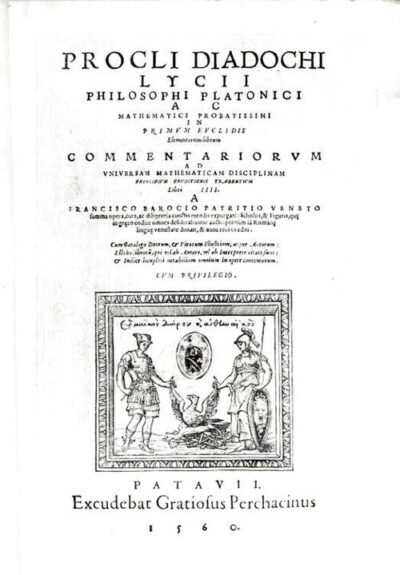
Proclus
Proclus was the 5th-century Greek Neoplatonist philosopher. Born February 8, 412, in Constantinople. Died April 17, 485, in Athens. Positions held include scholarch of the Platonic Academy (437–485). Known for Commentary on Euclid, Elements of theology and Platonic Theology.
Facts
19 facts · 2 confirmed by two sources · 4 cited · 13 from one source
Where this comes from
Papalocal keeps its own record. It started from these sources; what each one said is kept here as it was copied, so a change on their side never changes this page by itself. Tap one to read its version.
What Wikidata says · copied November 16, 2026 · revision 2567489426
- Described as
- 5th-century Greek Neoplatonist philosopher
- Other names
- Proclus Lycaeus
- Born
- February 8, 412 · 1 reference
- Died
- April 17, 485
- Born in
- Constantinople · 1 reference
- Died in
- Athens · 1 reference
- Name at birth
- Πρόκλος
- Citizen of
- Byzantine Empire
- Occupation
- philosopher · 1 reference; mathematician; mythographer; writer · 2 references
- Positions held
- scholarch of the Platonic Academy (437–485)
- Known for
- Commentary on Euclid; Elements of theology; Platonic Theology; Institutio physica; Short description of astronomical hypotheses
- Field
- philosophy; theology · 1 reference
- Lived in
- Proclus's House
- Wikipedias with a page
- 60
Wikidata item Q271809 (wikidata.org/wiki/Q271809), public domain (CC0). Copied November 16, 2026.
What Wikipedia says · copied November 16, 2026 · revision 1384895794
Proclus Lycius (; 8 February 412 CE – 17 April 485 CE), called Proclus the Successor (Ancient Greek: Πρόκλος ὁ Διάδοχος, Próklos ho Diádokhos), was a Greek Neoplatonic philosopher, one of the last major classical philosophers of late antiquity. He set forth one of the most elaborate and fully developed systems of Neoplatonism and, through later interpreters and translators, exerted an influence on Byzantine philosophy, early Islamic philosophy, scholastic philosophy, and German idealism, especially G. W. F. Hegel, who called Proclus's Platonic Theology "the true turning point or transition from ancient to modern times, from ancient philosophy to Christianity."
- Born, in its opening lines
- February 8, 412
- Died, in its opening lines
- April 17, 485
From the Wikipedia article “Proclus” (en.wikipedia.org/wiki/Proclus), by its contributors, under CC BY-SA 4.0 (creativecommons.org/licenses/by-sa/4.0/). Copied November 16, 2026; not changed.
Confirmed Two sources agree. Cited One source, and it names where it got it. One source One source, without a reference of its own. Sources disagree The sources disagree. We show the best-supported value and keep theirs below.
